Best Python Django Hosting Platforms in 2026: A Data-Led Comparison
Ask ten Django developers where they deploy and you will get ten answers, most of them defensive. That is because choosing among the best Python Django hosting platforms involves a trade-off nobody enjoys: managed platforms are easy until you need root, and raw infrastructure gives you root but hands you the whole operations burden.
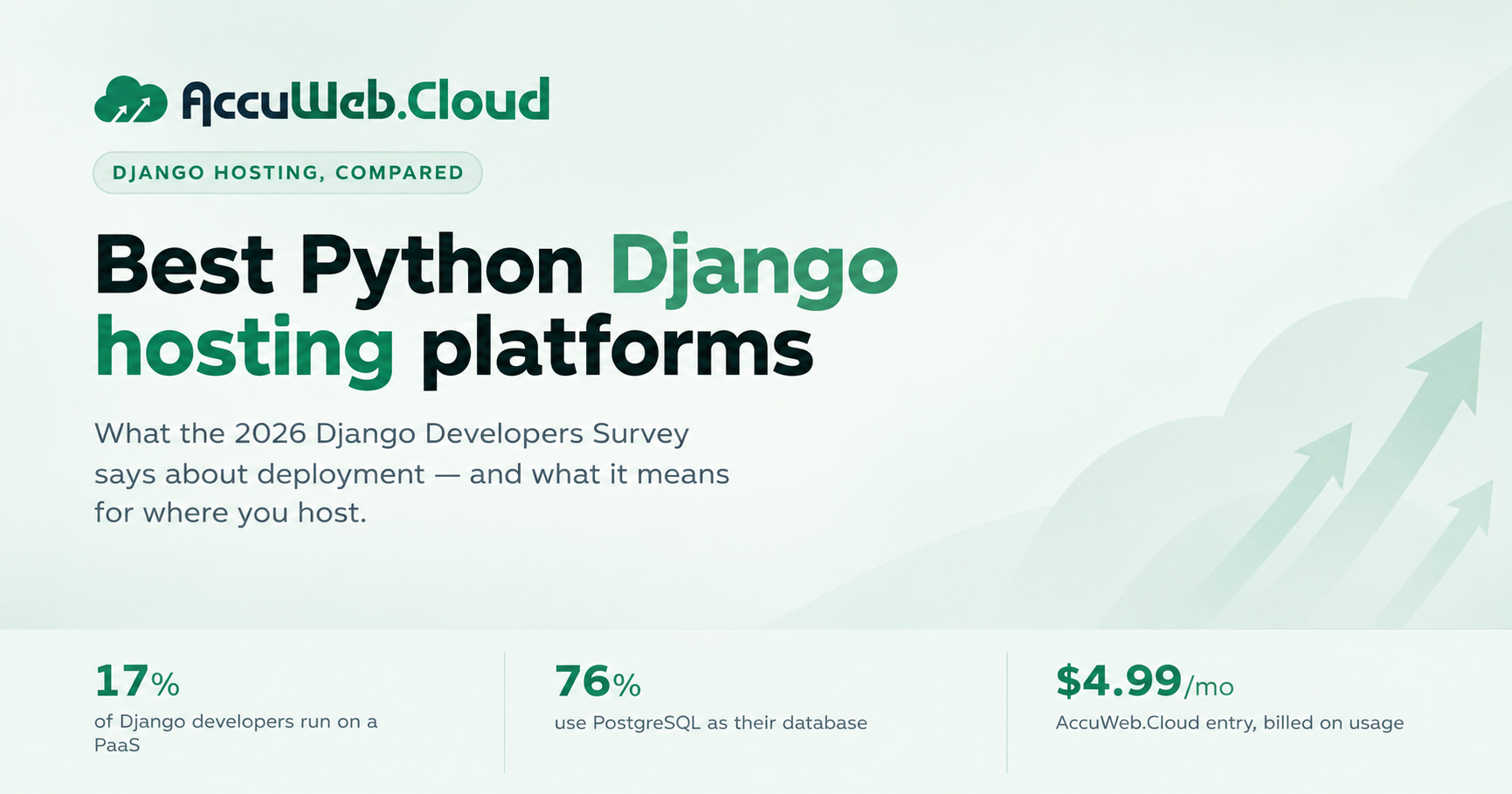
The data backs this up. In the 2025 Django Developers Survey — run by the Django Software Foundation with JetBrains across roughly 4,655 responses — only 17% of Django developers run their code on a platform-as-a-service. Meanwhile 51% run in containers and 41% on virtual machines. Django developers, overwhelmingly, want control.
This guide looks at what that data actually implies for your deployment decision, compares the realistic options on current pricing, and explains why Accuweb.cloud occupies a genuinely useful middle ground: root access and container support with the operational weight lifted, billed by actual usage rather than by plan tier.
Table of Contents
- TL;DR: Quick Answers
- What Django Developers Actually Run On
- Five Things That Actually Matter in Django Hosting
- Why AccuWeb.Cloud Fits Django Work
- The Pricing Model: Cloudlets and Pay-Per-Use
- Best Python Django Hosting Platforms Compared
- Reading the Numbers Honestly
- When Another Platform Is the Better Answer
- Deploying Django on AccuWeb.Cloud
- Frequently Asked Questions
- The Verdict
TL;DR: Quick Answers
| If you want… | Choose |
|---|---|
| Root access, containers, managed ops, usage billing | AccuWeb.Cloud |
| The simplest possible git-push deploy | Render or Railway |
| A learning sandbox with zero setup | PythonAnywhere free tier |
| Enterprise tooling and you already pay for it | AWS or Heroku |
| Lowest cost at genuine production scale | AccuWeb.Cloud pay-per-use |
What Django Developers Actually Run On
Before comparing vendors, it is worth grounding the discussion in what the community actually does. The 2025 Django Developers Survey, collected between November 2024 and January 2025, found:
- Where code runs: containers 51%, virtual machines 41%, platform-as-a-service 17%, serverless 8%.
- Cloud providers: AWS 38%, DigitalOcean 28%, Google Cloud 21%, Azure 9%, Heroku 9%.
- Databases: PostgreSQL 76%, SQLite 42%, MySQL 27%, MariaDB 9%.
- Containers in production: 44%, with 57% using them in development and 40% in CI/CD.
- Django versions: 5.1 at 62%, 4.2 at 45%, 5.0 at 31%. Python: 3.12 at 54%, 3.11 at 42%, 3.10 at 31%.
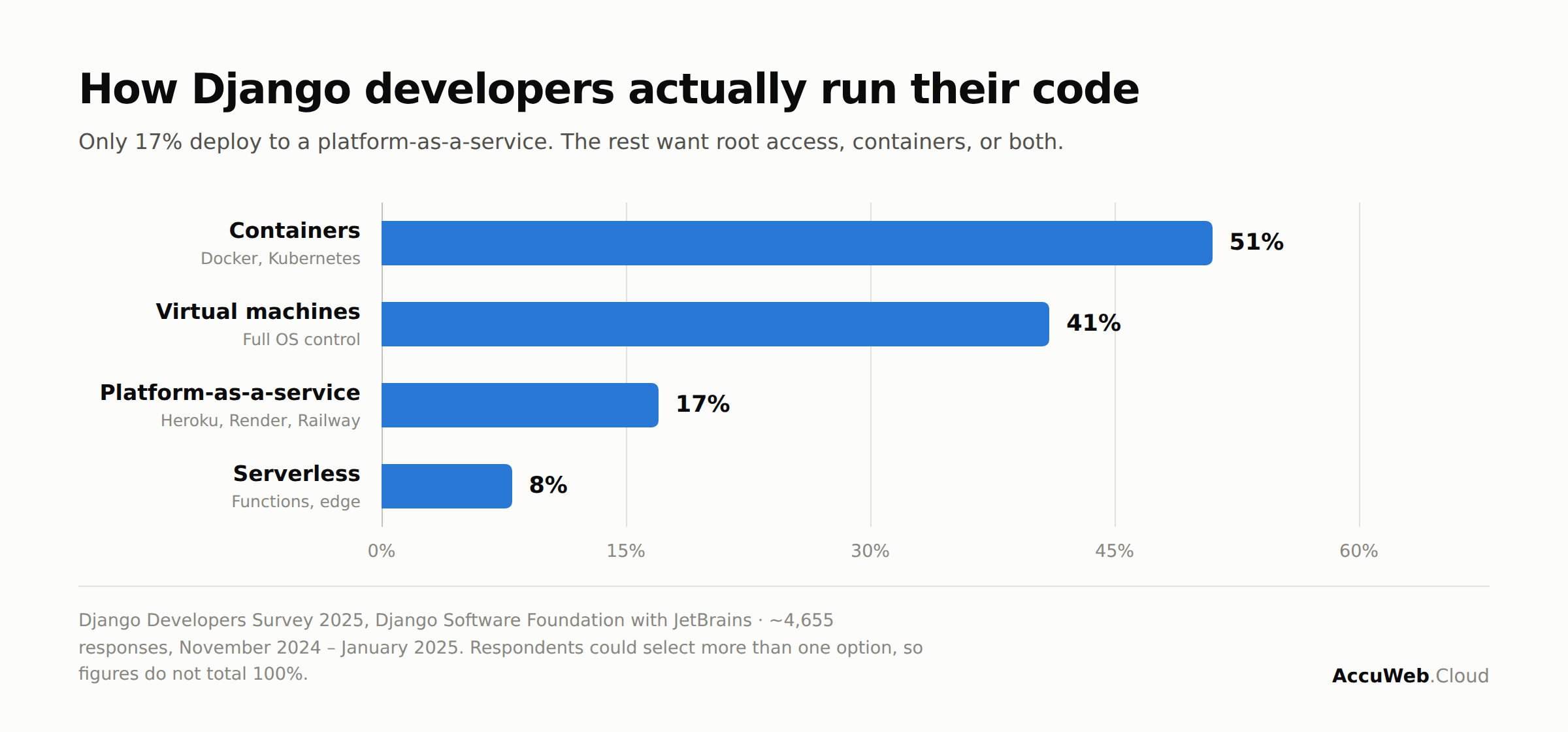
Three conclusions fall out of these numbers.
First, PaaS is a minority choice. Only 17%. The Django community has largely decided that the convenience of a fully abstracted platform is not worth the loss of control — and Heroku’s collapse to 9% adoption, after years as the default, tells that story clearly.
Second, PostgreSQL is effectively the standard. At 76%, any platform that treats Postgres as an afterthought or an expensive add-on is a poor fit for Django work specifically.
Third, version agility matters. With three Django versions and three Python versions all in heavy simultaneous use, being locked to whatever runtime your host blesses is a genuine constraint.
For context on the size of the ecosystem: the 2025 Stack Overflow Developer Survey, with around 49,000 respondents, put Python at 57.9% of all developers — fourth overall behind JavaScript (66%), HTML/CSS (61.9%) and SQL (58.6%) — and rising to 71.8% among people learning to code. Django itself was used by 12.6% of respondents and Flask by 14.4%.
Five Things That Actually Matter in Django Hosting
1. Can you install what you need?
Django projects accumulate system-level dependencies — GeoDjango needs GDAL and GEOS, image processing needs libjpeg and Pillow’s C extensions, PDF generation needs WeasyPrint’s system libraries. Platforms without root access turn each of these into a support ticket or a dead end.
2. What happens to idle time?
Most Django apps are not busy 24 hours a day. Fixed-plan hosting charges you for peak capacity around the clock. Usage-based billing charges for what you consume. Over a year, on a workload with genuine peaks and troughs, this is the difference that dominates the invoice.
3. Does it sleep?
Heroku’s Eco dyno sleeps after 30 minutes of inactivity. Render’s free tier spins down. Railway’s free plan caps at 1 vCPU and 0.5 GB. For a hobby project this is tolerable. For anything a customer touches, a cold start on first visit is a lost customer.
4. Is the database a first-class citizen?
With 76% of Django projects on PostgreSQL, database pricing is not a footnote. On Heroku, a production-grade Standard-0 Postgres instance is $50/month on top of your dyno. That add-on economics catches people out.
5. Who fixes it at 3am?
Raw VPS is cheap until something breaks and you are the operations team. Managed infrastructure with real engineering support is the difference between a bad hour and a bad week.
Why AccuWeb.Cloud Fits Django Work
AccuWeb.Cloud comes from AccuWeb Hosting, in business since 2002 — which in hosting terms means it has outlasted several generations of platforms that were going to change everything. The Python offering maps closely onto what that survey data says Django developers want.
Django, Flask and FastAPI, with your choice of server
The platform is explicitly “Django, Flask & FastAPI Ready.” You push code over SSH or Git and run it with Gunicorn, uWSGI, or your preferred WSGI server — not a mandated runtime wrapper. You can switch Python versions at any time or start from a clean environment, which matters when 3.10, 3.11 and 3.12 are all still in active use.
Full root access
You can “install any Python package with pip, or any system dependency your application needs.” This is the single clearest dividing line between AccuWeb.Cloud and the abstracted PaaS options, and it is precisely why 83% of Django developers are not on PaaS in the first place.
Databases pre-configured, not bolted on
Managed PostgreSQL, MySQL, MariaDB, MongoDB and Redis are available with pre-configured drivers and optimised connections. Given PostgreSQL’s 76% share among Django projects, and Redis being the default for Celery brokering and caching, having both as managed services on the same platform removes an entire category of integration work.
Containers and Kubernetes where you want them
With 51% of Django developers running in containers and 44% using them in production, Docker and Kubernetes support is not a niche requirement. AccuWeb.Cloud runs both alongside its managed application stack, so a containerised Django app and its managed Postgres can live in the same environment.
Scaling in both directions
The platform offers live vertical scaling — adding CPU and RAM without rebuilding — and automatic horizontal scaling for traffic peaks. Compute is described as “Dedicated vCPU and RAM. Not shared, not burstable,” which for a Django app under load is a meaningful distinction from burstable instances that throttle when you most need them.
Managed, with human support
24/7 in-house engineering support across US and Asian time zones, plus a free migration plan with staging setup — so moving an existing Django project is a supported process rather than a weekend you do not get back.
The Pricing Model: Cloudlets and Pay-Per-Use
This is where AccuWeb.Cloud diverges most sharply from plan-based hosting, and it is worth understanding properly because it is where the savings come from.
Resources are provisioned in small units called cloudlets. One cloudlet is 128 MiB of RAM and 200 MHz of CPU. Rather than buying a “plan” sized for your worst-case hour, you set a floor and let the ceiling move:
- Reserved cloudlets — the minimum RAM and CPU you expect to need at all times. These carry a discounted rate.
- Dynamic cloudlets — added and removed automatically with demand, billed at actual hourly usage.
AccuWeb.Cloud’s own worked example: “If you use 4 cloudlets or fewer, you pay for 4 cloudlets at the discounted Reserved Cloudlet price. If you use 16 cloudlets, you pay for 4 cloudlets at the Reserved price (since they are already allocated) and for 12 cloudlets at the Dynamic price.”
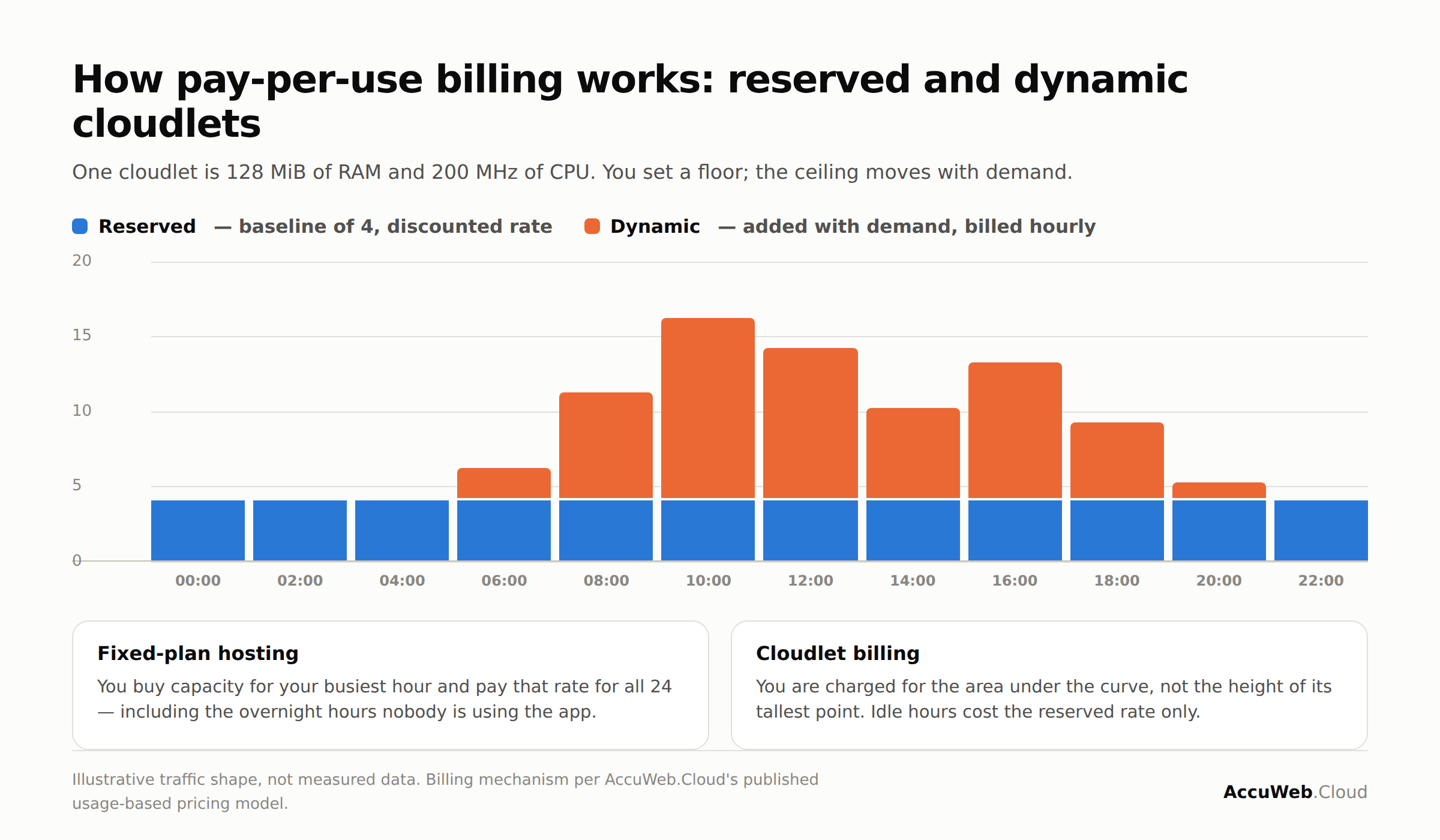
For a Django application this maps neatly onto reality. Your app idles overnight at its reserved floor. Your Monday morning traffic spike pulls in dynamic cloudlets for the hours it lasts, then releases them. You are billed for the area under the curve, not the height of its tallest point.
Compute and storage are priced separately — “NVMe-backed disk, priced per plan and separate from compute” — so a data-heavy, compute-light Django app is not forced to buy CPU it will never use. Billing is hourly or monthly, “billed for actual usage · cancel any time,” with entry pricing from $4.99/month. As a scale reference point, the published figure for 16 vCPU / 32 GB RAM / 50 GB SSD is $211.00/month (as of 1 August 2026). AccuWeb.Cloud backs its position with a stated “Guaranteed 40% Cloud Savings OR Get 100% Money Back” commitment against comparable providers.
Best Python Django Hosting Platforms Compared
| Platform | Model | Entry price | Root access | Sleeps when idle? | Managed Postgres |
|---|---|---|---|---|---|
| AccuWeb.Cloud | Managed cloud, pay-per-use | From $4.99/mo | Yes, full | No | Yes |
| Heroku | PaaS, fixed dynos | $5/mo Eco | No | Yes, Eco after 30 min | Add-on from $5/mo |
| Render | PaaS, fixed instances | $0 free / $7/mo | No | Yes, on free tier | Yes, free tier 256 MB |
| Railway | PaaS, usage-based | $5/mo Hobby | No | No | Yes |
| PythonAnywhere | Managed Python hosting | $0 free / $10/mo | No | No | MySQL only on paid |
A few specifics behind that table, all from the providers’ current published pricing:
- Heroku has had no free tier since 28 November 2022, when free dynos, hobby-dev Postgres and hobby-dev Redis were withdrawn. Eco is $5/mo and sleeps; Basic $7/mo; Standard-1X $25/mo for 0.5 GB RAM; Standard-2X $50/mo for 1 GB; Performance-M $250/mo. Production Postgres starts at $50/mo for Standard-0.
- Render offers a genuine free tier at 512 MB that spins down when idle. Paid starts at $7/mo for 0.5 CPU / 512 MB, $25/mo for 1 CPU / 2 GB, $85/mo for 2 CPU / 4 GB. Extra database storage is $0.30 per GB.
- Railway bills per second — memory at $0.00000386 per GB/sec and CPU at $0.00000772 per vCPU/sec, with egress at $0.05/GB. Hobby is $5/mo including $5 of usage credit; Pro is $20/mo including $20.
- PythonAnywhere is the friendliest on-ramp: a free Beginner tier with 1 web app, 100 CPU-seconds daily and 512 MB, and a Developer plan at $10/mo with 5,000 CPU-seconds daily and 5 GB. No SSH or MySQL on free.
Reading the Numbers Honestly
Entry prices across these platforms cluster between $5 and $10, which makes them look interchangeable. They are not, and the divergence appears in three places.
What the entry price buys. Heroku’s $25 Standard-1X dyno still gives you 0.5 GB of RAM. A Django app with Celery workers, a cache and a few hundred concurrent users will not fit comfortably. On cloudlet-based pricing you provision the RAM the app actually needs and pay by the hour rather than stepping up a fixed tier.
The database. On Heroku a production Postgres instance adds $50/month minimum. When Postgres is in 76% of Django projects, that is not an optional extra — it is part of the real price, and it should be compared as such.
The shape of your traffic. Fixed-plan hosting bills for peak capacity 24/7. If your Django app has pronounced peaks — a B2B tool idle at weekends, a campaign site with launch spikes, a service concentrated in one time zone — usage-based billing removes the cost of the hours nobody is using it.
When Another Platform Is the Better Answer
No honest hosting comparison ends with one winner in every column.
Choose PythonAnywhere if you are learning Django or running a small personal project and want the shortest possible path from tutorial to live URL. Its free tier is a genuinely good teaching environment.
Choose Render or Railway if your priority is developer experience above all else and your app has no unusual system dependencies. Git-push-to-deploy with zero infrastructure thinking is a real feature, and both do it well.
Choose AWS if you are already inside that ecosystem, need its specific managed services, or your organisation’s procurement has decided for you. At 38% adoption it is the Django community’s most common choice, and network effects are real.
Choose AccuWeb.Cloud when you want root access and container support without running the operations yourself, when your app has real system dependencies, when your traffic is uneven enough that usage billing beats fixed tiers, and when you want managed PostgreSQL and Redis alongside the application rather than stitched in from elsewhere.
Deploying Django on AccuWeb.Cloud
- Create the environment. Install Python from the one-click marketplace — AccuWeb.Cloud advertises server deployment in under 60 seconds — and pick your Python version.
- Add the database. Provision managed PostgreSQL in the same environment, with drivers pre-configured. Add Redis if you are using Celery or cache backends.
- Deploy your code. Push over Git or SSH, create your virtualenv,
pip install -r requirements.txt, and install any system packages you need with full root access. - Run it properly. Serve through Gunicorn or uWSGI, run
collectstatic, apply migrations, setDEBUG = Falseand configureALLOWED_HOSTS. - Set your scaling floor. Define reserved cloudlets for your steady-state load and enable auto-scaling so dynamic cloudlets absorb the peaks.
- Migrating an existing app? Use the free migration plan with staging, so you validate the new environment before cutting DNS across.
Frequently Asked Questions
What is the best hosting platform for Django in 2026?
It depends on whether you need root access. Given that 83% of Django developers run on containers or VMs rather than PaaS, most production projects are better served by a platform offering root and container support with managed operations — which is AccuWeb.Cloud’s position. For learning projects, PythonAnywhere’s free tier is hard to beat.
Does Heroku still have a free tier for Django?
No. Free dynos, hobby-dev Postgres and hobby-dev Redis were withdrawn on 28 November 2022. The cheapest option is now the Eco dyno at $5/month, which sleeps after 30 minutes of inactivity.
What is a cloudlet?
A cloudlet is AccuWeb.Cloud’s resource unit: 128 MiB of RAM and 200 MHz of CPU. Reserved cloudlets cover your baseline at a discounted rate; dynamic cloudlets are added and removed with demand and billed hourly on actual usage.
Can I run Celery, Redis and PostgreSQL together?
Yes. AccuWeb.Cloud offers managed PostgreSQL, MySQL, MariaDB, MongoDB and Redis, and full root access lets you run Celery workers and beat schedulers as you would on your own server.
Which Python versions are supported?
You can switch Python versions at any time or start from a clean environment — useful given that Python 3.12 (54%), 3.11 (42%) and 3.10 (31%) are all in widespread Django use simultaneously.
Will my Django app sleep when traffic is low?
No. Reserved cloudlets keep your baseline allocation running continuously. Unlike Heroku’s Eco dyno or Render’s free tier, there is no spin-down and no cold start on the first visit after a quiet period.
Can I migrate an existing Django project?
Yes. AccuWeb.Cloud provides a free migration plan including staging setup, so the application can be validated in the new environment before DNS is switched.
The Verdict
The survey data makes the shape of this decision unusually clear. Django developers have voted with their deployments: only 17% accept the constraints of a pure PaaS, while 51% run containers and 41% run VMs. They want root access, real databases, and the freedom to choose their own runtime and WSGI server.
Historically that meant accepting the operations burden that comes with raw infrastructure. AccuWeb.Cloud’s proposition is that you should not have to: root access, Docker and Kubernetes, managed PostgreSQL and Redis, your choice of Python version and WSGI server, live vertical and automatic horizontal scaling — with 24/7 engineering support and billing that follows your actual usage rather than your worst hour, starting at $4.99/month.
Among the best Python Django hosting platforms, that combination is rarer than it should be. If your Django app has outgrown a hobby tier but has not earned a dedicated operations engineer, it is the gap worth looking at.
Deploy your Django app on AccuWeb.Cloud → Root access, managed databases, pay only for what you use.

Jilesh Patadiya, the visionary Founder and Chief Technology Officer (CTO) behind AccuWeb.Cloud. Founder & CTO at AccuWebHosting.com. He shares his web hosting insights on the AccuWeb.Cloud blog. He mostly writes on the latest web hosting trends, WordPress, storage technologies, and Windows and Linux hosting platforms.