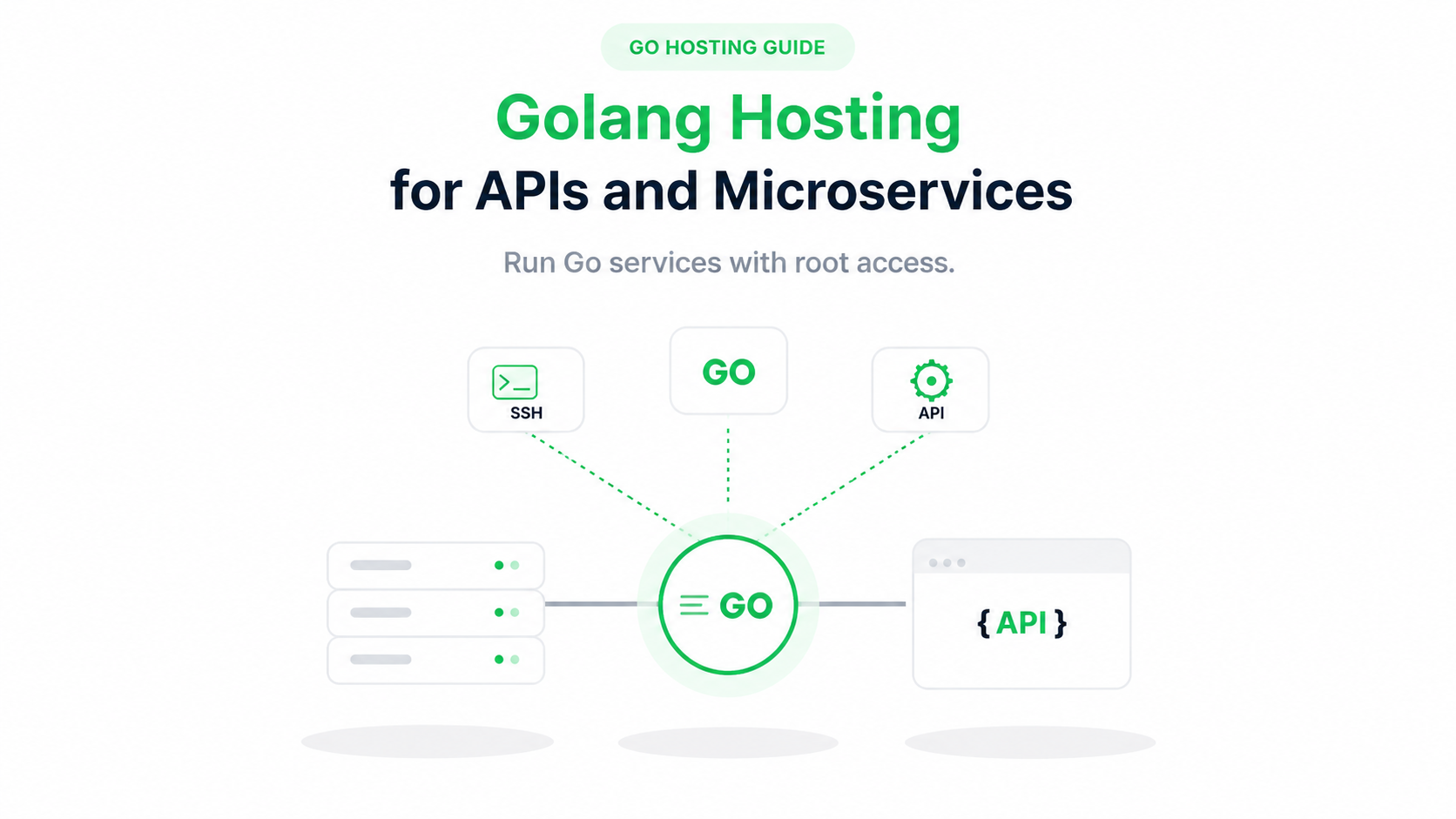
Golang Hosting for Microservices and REST APIs With Root Access
Your Golang binary compiles in a couple of seconds. Then comes the part that eats the rest of the afternoon: finding a server where it can actually run, with the right ports open, a process keeping it alive and HTTPS sitting in front of it.
That is the gap AccuWeb.Cloud Golang Hosting is built to close. You get a pre-installed Golang runtime, one-click deployment, SSH access and full root access, so you control the server that runs your binaries. Plans start at $4.95 per month or $0.006781 per hour, a complimentary seven-day disaster-recovery backup is included, and a 30-day money-back guarantee backs your first deployment.
Microservices and REST APIs both depend on the server around your code. Each microservice runs as its own process on its own port, and every REST API needs a reliable network path, firewall rules and HTTPS in front of it. With full root access, you set all of that up yourself, including custom ports, background services, reverse proxies, private networking and SSH keys, rather than relying only on an application dashboard. That is the control that lets a Golang API and its supporting services run as one clean, well-organized system.
The price gap is worth a look too. The Standard plan (2 vCPU, 4 GB RAM) costs $11.75 per month, which is about 41% to 51% less over a year than same-size plans from DigitalOcean, Vultr and Linode.
In this guide, you’ll see the plans and pricing, how they compare with other providers, why microservices and REST APIs need root access, how to use root access safely, how to expose a REST API without exposing everything, and which deployment mistakes to avoid. Let’s break this down.
TL;DR: Quick Answers
Bottom line: If you want a server with the Golang runtime already installed, full root and SSH control, and billing by the hour or the month, Golang Hosting is built for REST APIs, microservices, SaaS backends and web services. Start with the plan that fits your service today, and scale CPU, RAM and storage as traffic grows.
| What You Want to Know | Quick Answer |
|---|---|
| Starting price | $4.95 per month or $0.006781 per hour |
| Plans | Seven plans, from 1 vCPU and 1 GB RAM up to 8 vCPU and 32 GB RAM |
| Golang environment | Pre-installed Golang runtime with one-click deployment, compilation and Golang modules |
| Server control | Full root access, SSH keys, custom ports and background services |
| Microservices and REST APIs | Run each service on its own port as a background service, route traffic through a reverse proxy and use public and private networking, all with full root access |
| Backups | Complimentary seven-day disaster-recovery backup |
| Billing and guarantee | Hourly or monthly billing, with a 30-day money-back guarantee (terms apply) |
| Locations | New York, Los Angeles, Frankfurt and Mumbai |
| Free trial | A separate cloud VM trial runs for up to 14 days |
Why Microservices and REST APIs Need Root Access
Microservices split an application into small services that each do one job, such as handling requests, processing orders or running background tasks. REST APIs are the doorway to those services: they let your front end, mobile apps and other systems talk to your Golang code over HTTP. Both designs depend on server-level decisions, including which port each service listens on, how traffic is routed, which connections stay private and how every process starts and stops.
That is where root access pays off. With full root access on AccuWeb.Cloud Golang Hosting, you configure the server around your services instead of relying only on an application dashboard.
What Root Access Gives Your Microservices
- Separate processes: run each microservice as its own background service and manage the processes yourself.
- Custom ports: give every service a clear port or communication path.
- Private networking: connect services and databases over private networking, and keep internal ports off the public path.
- Firewall controls: allow only the network paths each service needs.
- Your own toolset: install additional development tools and manage dependencies and Golang modules directly on the server.
What Root Access Gives Your REST APIs
- Reverse proxy: receive client requests in one place and route them to the right Golang service.
- HTTPS: configure HTTPS where it fits your routing design, such as at the reverse proxy.
- SSH key access: administer the server securely with SSH key authentication.
- Environment variables: change settings between deployments without rebuilding your binary.
- Database connections: connect to an external database or to a database over private networking.
| Root Access Capability | Microservices Benefit | REST API Benefit |
|---|---|---|
| Custom ports | Each service gets its own port | Your API listens where clients expect it |
| Background services | Workers run alongside the API | Longer tasks continue without holding a request open |
| Reverse proxy | Traffic is routed between services | Client requests reach the right endpoint |
| Private networking | Services and databases talk privately | Database connections stay off the public path |
| Firewall controls | Each service shows only what it needs to | Only the endpoints clients need are open |
These capabilities are available on every AccuWeb.Cloud Golang Hosting plan.
A Sample Golang Microservices Layout
A SaaS backend shows how the pieces fit together. One service accepts API requests, a second service handles longer background tasks, and the database sits on private networking. A reverse proxy stands in front, so clients reach only the API while the worker and the database stay on private paths.
Root access lets you build that layout on your own server and grow it service by service. You can start on a Start or Essential plan at $4.95 or $6.95 per month, then move up to Standard or Plus as traffic grows. Every plan includes the pre-installed Golang runtime, one-click deployment, SSH access and full root access, so the same foundation is there whether you run one REST API or a full set of microservices.
Golang Hosting Plans and Pricing
Golang Hosting on AccuWeb.Cloud starts at $4.95 per month, or $0.006781 per hour, and grows to 8 vCPU and 32 GB of RAM. There are seven plans, so you can start with the size your Golang service needs today and move up as traffic and workloads grow. Every plan is billed hourly or monthly, and a 30-day money-back guarantee backs your first deployment.
| Plan | Best for | vCPU | RAM | NVMe storage | Per month | Per hour |
|---|---|---|---|---|---|---|
| Start | Personal sites and dev testing | 1 | 1 GB | 12 GB | $4.95 | $0.006781 |
| Essential | Small blogs and starter projects | 1 | 2 GB | 15 GB | $6.95 | $0.009507 |
| Standard (Most Popular) | Growing sites and e-commerce | 2 | 4 GB | 35 GB | $11.75 | $0.016096 |
| Plus | High-traffic sites and web apps | 2 | 8 GB | 50 GB | $15.95 | $0.021863 |
| Power | Agencies and busy databases | 4 | 8 GB | 85 GB | $21.95 | $0.030096 |
| Premium | Intensive multi-user workloads | 4 | 16 GB | 105 GB | $29.75 | $0.040795 |
| Ultimate | High-demand enterprise apps | 8 | 32 GB | 140 GB | $52.95 | $0.072507 |
Prices in USD. All plans are available in New York, Los Angeles, Frankfurt and Mumbai. Custom vCPU, RAM and NVMe configurations are also available.
What Every Plan Includes
- Golang-ready environment: a pre-installed Golang runtime with one-click deployment.
- Full control: root access and SSH access, so you manage modules, ports, processes and services your way.
- 1 TB of bandwidth and one dedicated public IP address on every plan.
- NVMe storage for fast reads and writes.
- Free SSL support and free migration.
- Backups and snapshots available, along with a complimentary 7-day disaster-recovery backup.
- Fully managed support and access to the App Marketplace.
Choose the Plan That Fits Your Golang Service
Start with the workload you need to run, then pick the plan that gives it room.
- Start and Essential suit a first REST API, a prototype or a development and testing environment. Start gives you 1 vCPU and 1 GB of RAM for $4.95 per month, and Essential doubles the RAM to 2 GB.
- Standard is the most popular choice. With 2 vCPUs and 4 GB of RAM, it gives a production API room for request handling alongside a background worker.
- Plus and Power fit busier services. Plus raises the RAM to 8 GB, and Power adds 4 vCPUs for compute-heavy work and busy databases.
- Premium and Ultimate are built for larger microservice stacks, multi-user SaaS backends and enterprise applications, with up to 8 vCPUs and 32 GB of RAM.
You can also increase CPU, RAM and storage later, so your first plan does not have to be your last.
Hourly and Monthly Billing
Hourly billing lets you pay only for the hours a server runs. A Start instance that runs for 100 hours costs about $0.68, and a Standard instance for 100 hours costs about $1.61. That makes it simple to test a new service, run a short-lived staging environment or try a different size before you settle on a monthly plan.
Monthly billing suits services that run all the time, such as a production API. Hourly and monthly billing describe how you pay, so each service in your architecture can use whichever fits it.

Separate Billing From Architecture
Hourly and monthly billing describe how usage is billed. They do not determine whether your application runs as one process or several services.
Before choosing, outline the API, its background workers, and its database connections. That inventory gives you a clearer basis for selecting resources than the number of repositories alone.
Golang Hosting Price Comparison: AccuWeb.Cloud vs DigitalOcean, Vultr and Linode
Cost is one of the first things teams compare when choosing a home for a Golang API or microservice. Matching plans by vCPU and RAM is the clearest way to do it, because those two numbers shape how many requests and background workers a server can handle. The table below places the AccuWeb.Cloud Golang Hosting Standard plan next to the 2 vCPU, 4 GB plans from three widely used cloud providers.
| Provider | Plan | vCPU | RAM | Monthly price | 12-month cost |
|---|---|---|---|---|---|
| AccuWeb.Cloud | Standard | 2 | 4 GB | $11.75 | $141.00 |
| DigitalOcean | Basic Droplet | 2 | 4 GB | $24.00 | $288.00 |
| Vultr | Regular Cloud Compute | 2 | 4 GB | $20.00 | $240.00 |
| Linode (Akamai) | Shared CPU | 2 | 4 GB | $24.00 | $288.00 |
Prices in USD at the same vCPU and RAM. AccuWeb.Cloud is billed hourly or monthly, and the other providers are shown at their monthly list prices. Provider prices checked in November 2026 and may change.
Over a year, the Standard plan comes to $141.00. That is a saving of $99.00 to $147.00 against the same-size plans above, or about 41% to 51% less.
What You Save at Each Size
- Against DigitalOcean: $12.25 less every month, or $147.00 over 12 months.
- Against Vultr: $8.25 less every month, or $99.00 over 12 months.
- Against Linode: $12.25 less every month, or $147.00 over 12 months.
- At 8 GB of RAM: the Plus plan costs $15.95 per month, compared with $40 to $48 for an 8 GB plan from the same providers.
The lower price still comes with a complete setup. Every AccuWeb.Cloud Golang Hosting plan includes NVMe storage, 1 TB of bandwidth, a dedicated public IP, free SSL, free migration and full root access. Billing is by the hour or by the month, and a 30-day money-back guarantee backs your first deployment. That leaves more of your budget for the databases, workers and extra services a growing Golang backend needs.
Deploy Golang Services With Full Root Access
A Golang API needs somewhere to run after the build succeeds. It also needs a network path for requests and a way to keep its process running.
AccuWeb.Cloud Golang Hosting supports compilation and Golang modules on a server with the runtime already installed. You can deploy with one click, connect through SSH, and administer the environment with full root access.
Use Root Access Deliberately
Root access lets an administrator configure the server rather than relying only on an application dashboard. That control is useful when an API needs a custom port, a background service, or a reverse proxy.
Use SSH key authentication for administrative connections. Keep routine application work separate from privileged administration, and restrict network access to the services that need it.
Recover From an Incident
Golang Hosting includes a complimentary seven-day disaster-recovery backup. Optional backup policies and snapshots offer additional ways to organize recovery.
Include application configuration and database recovery in your own recovery process. A server backup and an application recovery procedure address different parts of an incident.
Select for the Application
Choose the Golang-specific offer when your priority is a pre-installed runtime and control over your application process. It supports REST APIs, microservices, SaaS backends, and web services. Keep the Golang workload and its required resources in view as you compare options.
Give Each Golang Service a Clear Role
Golang VPS hosting for microservices works best when each process has an explicit responsibility. One service can accept API requests, while another handles work that should continue in the background.
For example, a SaaS backend can accept requests through an API and pass longer tasks to a worker. The worker runs as a background service rather than holding the request open.
Configure Ports and Processes
Golang Hosting supports custom ports and background services. Assign each process a clear port or communication path, then document how it starts and stops.
A reverse proxy can receive incoming traffic and route requests to the appropriate application process. Keep internal service ports out of the public path unless a client needs direct access.
Keep Configuration Outside the Binary
Use environment variables for settings that change between deployments. Examples include a listening address, an application mode, and a database connection setting.
Keep sensitive values out of source code and build artifacts. Restrict access to the configuration, and update your deployment process when a value changes.
For dedicated Golang backend hosting, map each service to its resources and dependencies before deployment. The goal is to know which process handles a request and where that process sends its data.
Expose a REST API Without Exposing Everything
Golang REST API server hosting involves more than starting a binary. A reachable application needs a listening address, firewall rules, routing, and HTTPS configuration.
Separate Public and Private Paths
Golang Hosting supports public and private networking, firewall controls, and reverse proxies. Decide which endpoint clients should reach and which connections belong on a private network.
A public API endpoint can receive client requests. A database connection can use a private network or an external database connection, depending on the architecture you choose.
Allow only the network paths your application requires. Review firewall rules whenever you add a worker, database connection, or administrative endpoint.
Configure HTTPS for Clients
Golang Hosting supports HTTPS when configured. Place HTTPS configuration where it fits your routing design, such as the reverse proxy handling incoming requests.
Test the public endpoint after configuration. Check that requests reach the intended service and that private endpoints do not become public by accident.
Also consider application behavior behind the proxy. Your service should handle the request path and configuration your proxy sends to it.
Match Resources to the Workload
A small API and a busy SaaS backend place different demands on a server. Look at compilation, request handling, background jobs, and stored data together.
Golang Hosting supports increases to CPU, RAM, and storage. Track application behavior over time and use that evidence to decide which resource needs attention.
Use the Cloud VM Trial Separately
The separate cloud VM trial runs for up to 14 days and includes 1 vCPU, 1 GB RAM, and 10 GB storage. It is a cloud VM offer rather than a named Golang Hosting plan.
Use a trial environment to become familiar with cloud server workflows. Keep its configuration separate from your production workload and any Golang-specific purchasing decision.
Watch the Whole Request Path
CPU use is only part of the picture. An API also depends on memory, storage, network connections, and the responsiveness of services it calls.
For golang SaaS backend hosting, observe the API and its workers together. A queue of background tasks can reveal a different resource need from slow request handling.
Compare your hosting options against your application requirements, and keep the selected Golang offer distinct from other cloud products when you do.
Choose a Location and Recovery Approach
Golang Hosting is available in four locations: New York, Los Angeles, Frankfurt, and Mumbai. Choose a location with your users, connected services, and operating requirements in mind.
Consider where the database runs as well as where users connect. An API that frequently calls another service depends on that connection throughout a request.
Make Recovery Part of the Design
The included disaster-recovery backup is a starting point. Decide how you will restore application files, configuration, and data after a disruption.
Snapshots and optional backup policies give you additional recovery options. Document which parts of the system each recovery method covers and who handles the restore.
Account for Server Administration
Root access gives your team control over server configuration. Assign responsibility for changes, credentials, process supervision, and firewall rules.
AccuWeb.Cloud Cloud VPS includes 24/7 fully managed support, which helps with your broader server operations.
Keep a record of changes to ports, environment variables, and dependencies. That record helps the team understand the running system during maintenance or recovery.
Avoid Common Golang Deployment Mistakes
Several mistakes can make a healthy binary look like a hosting problem. Check the application process and its network path before changing the server configuration.
- Do not expose a worker port when only the API needs public traffic.
- Do not leave database credentials inside the source code.
- Do not assume a running process is listening on the intended address.
- Do not overlook the reverse proxy when an API route fails.
- Do not treat a server backup as a complete database recovery procedure.
For a failed request, follow the path from the client to the proxy and then to the Golang process. Review the application’s logs and configuration at each point.
Golang Hosting Terms Worth Knowing
These terms help distinguish application behavior from the server controls around it.
- Root access. Administrative access for configuring the server.
- SSH key. A credential used to authenticate an SSH connection.
- Reverse proxy. A service that receives requests and routes them to an application.
- Environment variable. A configuration value available to a running process.
- Background service. A process that runs independently of an interactive session.
These concepts work together. For example, a reverse proxy can route a request to a Golang background service configured through environment variables.
Frequently Asked Questions
Can I Host a Golang REST API on a VPS?
Yes. A VPS can run a Golang binary and expose an API through a configured network path. AccuWeb.Cloud Golang Hosting supports REST APIs and custom ports.
Can I Compile Golang Code on the Server?
Yes. Golang Hosting supports compilation, Golang packages, and modules. The Golang runtime is pre-installed.
Does Golang Hosting Include Root and SSH Access?
Golang Hosting includes full root access and SSH access. It also supports SSH key authentication.
Can I Run Golang Microservices as Background Processes?
Yes. Golang Hosting supports background services. Organize each process around its responsibility and configure how it starts and stops.
Can a Golang API Listen on a Custom Port?
Yes. Golang Hosting supports custom ports. Use firewall controls and routing to expose only the intended endpoints.
How Does a Golang Service Connect to a Database?
Golang Hosting supports external database connections and connections over a private network. Store connection settings securely and restrict the network path.
Can I Use HTTPS With a Golang API?
Yes. Golang Hosting supports HTTPS when configured. A reverse proxy can form part of your incoming request path.
Where Can I Run a Golang Backend?
AccuWeb.Cloud Golang Hosting is available in New York, Los Angeles, Frankfurt, and Mumbai. Consider your users and connected services when choosing a location.
Bring Your Golang Backend Into Focus
Start with the process and network design, then choose resources and a recovery approach that fit the workload. Golang hosting for microservices and REST APIs with root access gives your team a foundation for compiling, running, and exposing Golang services.

Jilesh Patadiya, the visionary Founder and Chief Technology Officer (CTO) behind AccuWeb.Cloud. Founder & CTO at AccuWebHosting.com. He shares his web hosting insights on the AccuWeb.Cloud blog. He mostly writes on the latest web hosting trends, WordPress, storage technologies, and Windows and Linux hosting platforms.