Golang Hosting for Background Workers and Internal Tools
Your queue consumer stops at 3 a.m. A scheduled command quietly never runs. The internal dashboard your team relies on is still living on someone’s laptop. Golang is built for exactly this kind of work, but it needs a home that stays on, restarts cleanly, and keeps private services private.
Golang hosting for background workers and internal tools gives your Golang processes an always-on server with root access. AccuWeb.Cloud Golang Hosting starts at $4.95 per month on the shared Start plan, including a preinstalled Golang runtime, 1 vCPU, 1 GB RAM, and 12 GB NVMe storage.
In this guide, you will compare plans and entry-level prices, size worker concurrency, design for safe restarts, connect services to databases over private networking, and choose a backup rhythm. Everything is aimed at queue consumers, scheduled commands, internal applications, and network daemons you control over SSH.
TL;DR
- The shared Start plan begins at $4.95 per month with 1 GB RAM and 12 GB NVMe storage.
- Root and SSH access let teams manage background processes and internal applications.
- Private networking connects Golang services to databases without making every service public.
- Choose a larger plan when worker concurrency, memory use, or CPU demand needs more capacity.
- Optional hourly, daily, or weekly backup policies complement instance and volume snapshots.
Choose a Server for Your Golang Workload
Start with the memory your processes need together, then check CPU and storage. The shared plans in the AccuWeb.Cloud pricing range include storage, 1 TB bandwidth, one dedicated IP, fully managed support, and free migration.
| Plan | Monthly price | vCPU | RAM | NVMe storage |
|---|---|---|---|---|
| Start | $4.95 per month | 1 vCPU | 1 GB | 12 GB |
| Essential | $6.95 per month | 1 vCPU | 2 GB | 15 GB |
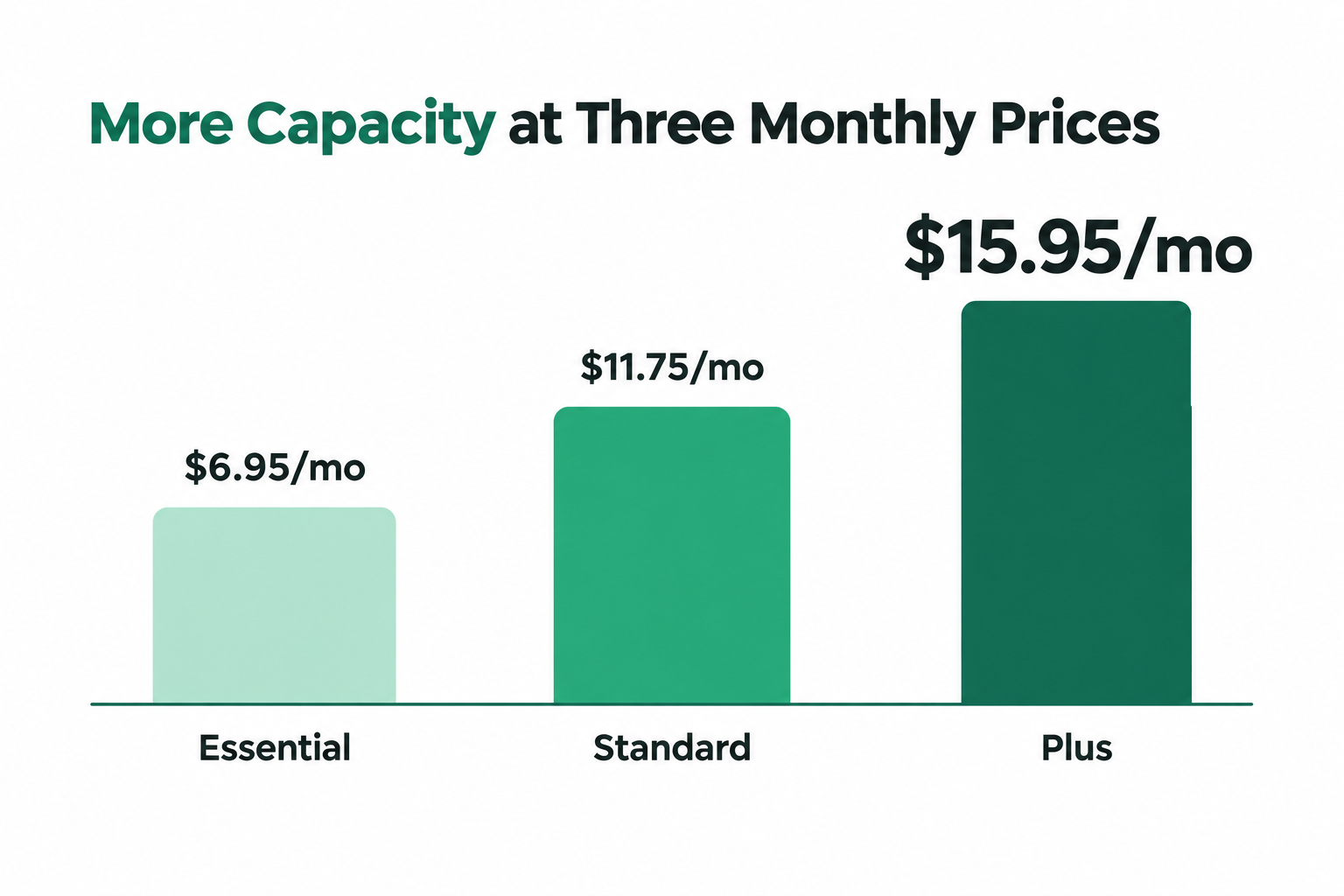
| Standard | $11.75 per month | 2 vCPUs | 4 GB | 35 GB |
| Plus | $15.95 per month | 2 vCPUs | 8 GB | 50 GB |
| Power | $21.95 per month | 4 vCPUs | 8 GB | 85 GB |
| Premium | $29.75 per month | 4 vCPUs | 16 GB | 105 GB |
| Ultimate | $52.95 per month | 8 vCPUs | 32 GB | 140 GB |
Choose Essential when you need more memory than Start while keeping one vCPU. Choose Standard when your workers also need a second vCPU. Plus increases RAM to 8 GB, while Power keeps 8 GB and adds two more vCPUs.
For dedicated compute, Compute-Nano costs $9.50 per month. Add 10 GB of NVMe storage at $0.60 per month for a working setup costing $10.10 per month: $9.50 + $0.60.
Capacity depends on the whole machine, not just the Golang binary. Allow room for the operating system, logs, queued work, and any other processes on the server.
Compare Entry-Level Worker Servers
AccuWeb.Cloud Start costs $4.95 per month for a server with 1 GB RAM. The comparison uses entry-level Linux server plans with roughly 1 GB of memory, the resource matched first for a small worker.
| Measure | AccuWeb.Cloud | DigitalOcean | Akamai | Amazon Lightsail |
|---|---|---|---|---|
| Plan | Start, shared | Basic Droplet, Regular | Shared CPU Nanode | Linux/Unix General Purpose, public IPv4 |
| Starting monthly price | $4.95 | $6 | $5 | $7 |
| Memory | 1 GB | 1 GiB | 1 GB | 1 GB |
| CPU | 1 vCPU | 1 vCPU | 1 CPU | 2 vCPUs |
| Storage | 12 GB NVMe | 25 GiB SSD | 25 GB | 40 GB SSD |
| Transfer | 1 TB | 1,000 GiB | 1 TB | 2 TB, with regional exceptions |
| Billing | Monthly or hourly | Per-second usage with monthly cap | Hourly or monthly | Monthly |
For these entry plans, Start has the lowest monthly price. Amazon Lightsail has more listed CPU and storage. DigitalOcean measures memory in GiB, which is slightly larger than a decimal GB.
In Capterra reviews, DigitalOcean customers praise documentation and scalability, while some mention support delays. Review-site feedback praises Akamai’s reliability but also mentions verification or support concerns. In review-site summaries of Reddit discussions, Lightsail users praise setup and predictable pricing; some mention CPU performance or outages.
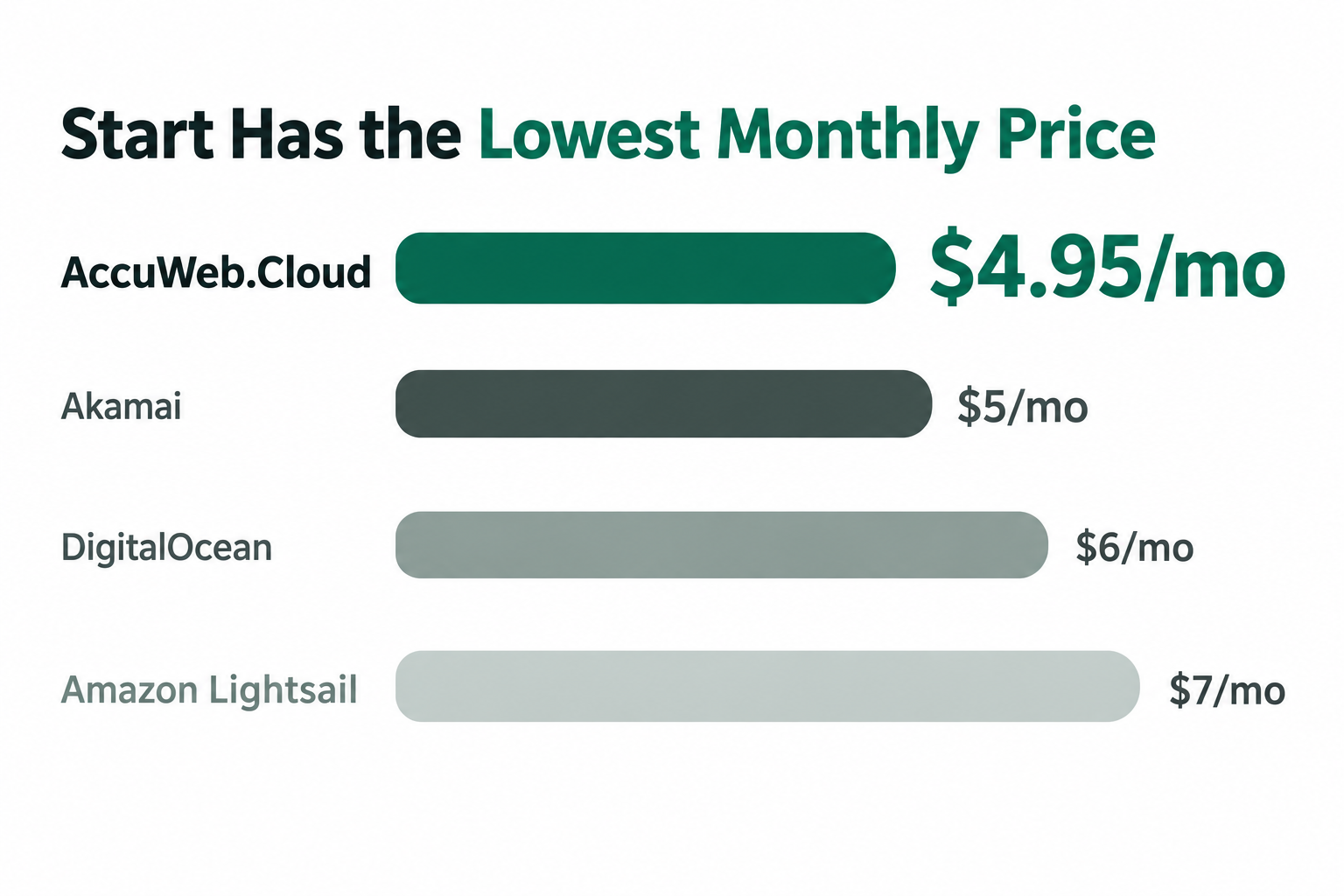
For a three-month planning example, use one continuously running entry server at each listed monthly price. AccuWeb.Cloud costs $4.95 × 3 = $14.85; DigitalOcean costs $6 × 3 = $18; Akamai costs $5 × 3 = $15; and Lightsail costs $7 × 3 = $21.
These totals use the plan prices above and exclude separately billed usage or add-ons. Compare the resources your worker actually needs, especially disk space and CPU, before choosing solely on the monthly total.
Keep Background Jobs Running Reliably
A worker needs more than a running server: it needs a way to start, stop, recover, and handle work safely. Root access gives your team control over how Golang processes run on the instance.
Match Concurrency to the Queue
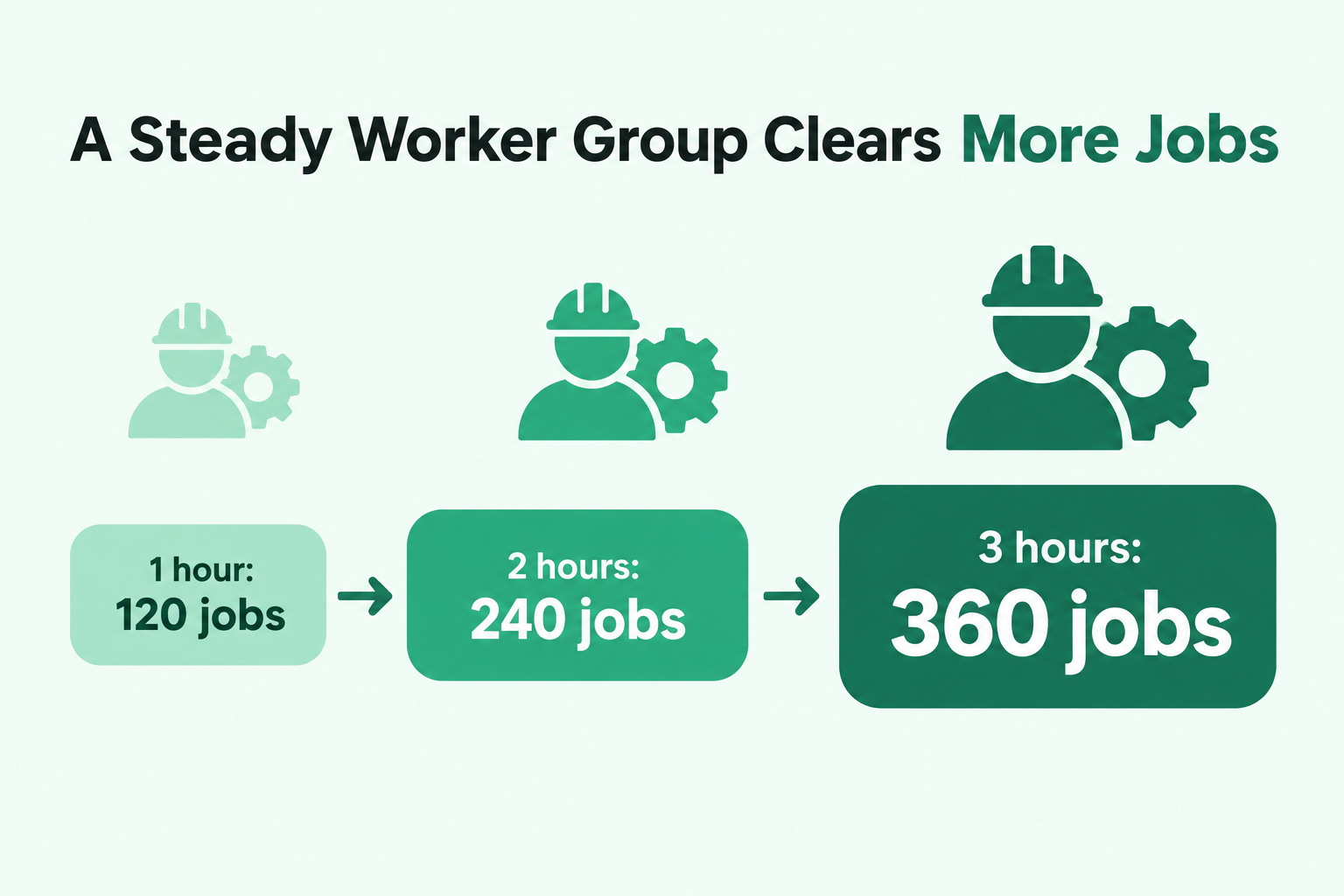
Consider a planning example with 120 jobs arriving per hour and three workers. If work divides evenly, each worker handles 120 ÷ 3 = 40 jobs per hour. This is a sizing estimate, not a throughput guarantee.
At that assumed rate, the group processes 120 jobs in one hour, 240 in two hours, and 360 in three hours. If arrivals exceed completed jobs for long enough, the backlog grows. Watch queue depth as well as CPU and memory before adding worker processes.
More workers are not always better. Each process consumes memory, and CPU-heavy jobs compete for the same cores. If jobs wait on a database, additional concurrency can also increase database connections and lock contention.
Design for Restarts and Duplicate Work
A process manager can start the worker after a reboot and restart it after a failure. Choose and configure a supervisor that fits your operating system and deployment workflow. AccuWeb.Cloud gives you the root and SSH access needed for process control.
Make jobs safe to retry where possible. A worker can finish an external action and stop before recording completion. A retry could then repeat that action, so use durable job state or an idempotency key, a value that identifies the same operation across retries.
On shutdown, stop accepting new jobs, finish or release current work, and record progress. Test that behavior before relying on automated restarts. Also alert on repeated failures: a worker that restarts continuously is not necessarily processing useful work.
Connect Internal Tools Without Exposing Everything
AccuWeb.Cloud Golang Hosting includes public and private networking, firewall controls, and SSH key authentication. Use these controls to separate an internal application’s access path from its database connection.
Separate Access Paths
Keep a database connection on the private network when the application and database use that network. Restrict public inbound access to the ports that users or external systems actually need. A background worker that only pulls jobs from a private service does not need a public application port for that task.
For an internal web tool, decide who needs browser access and configure HTTPS. Store credentials outside the Golang binary using environment variables, and limit access to those values. Treat SSH keys as administrator credentials, not as application secrets.
AccuWeb.Cloud offers Golang Hosting in four locations: New York, Los Angeles, Frankfurt, and Mumbai. Choose a location close to the systems your worker talks to most often. Review the broader data center information when location matters to your architecture.
Choose a Recovery Rhythm
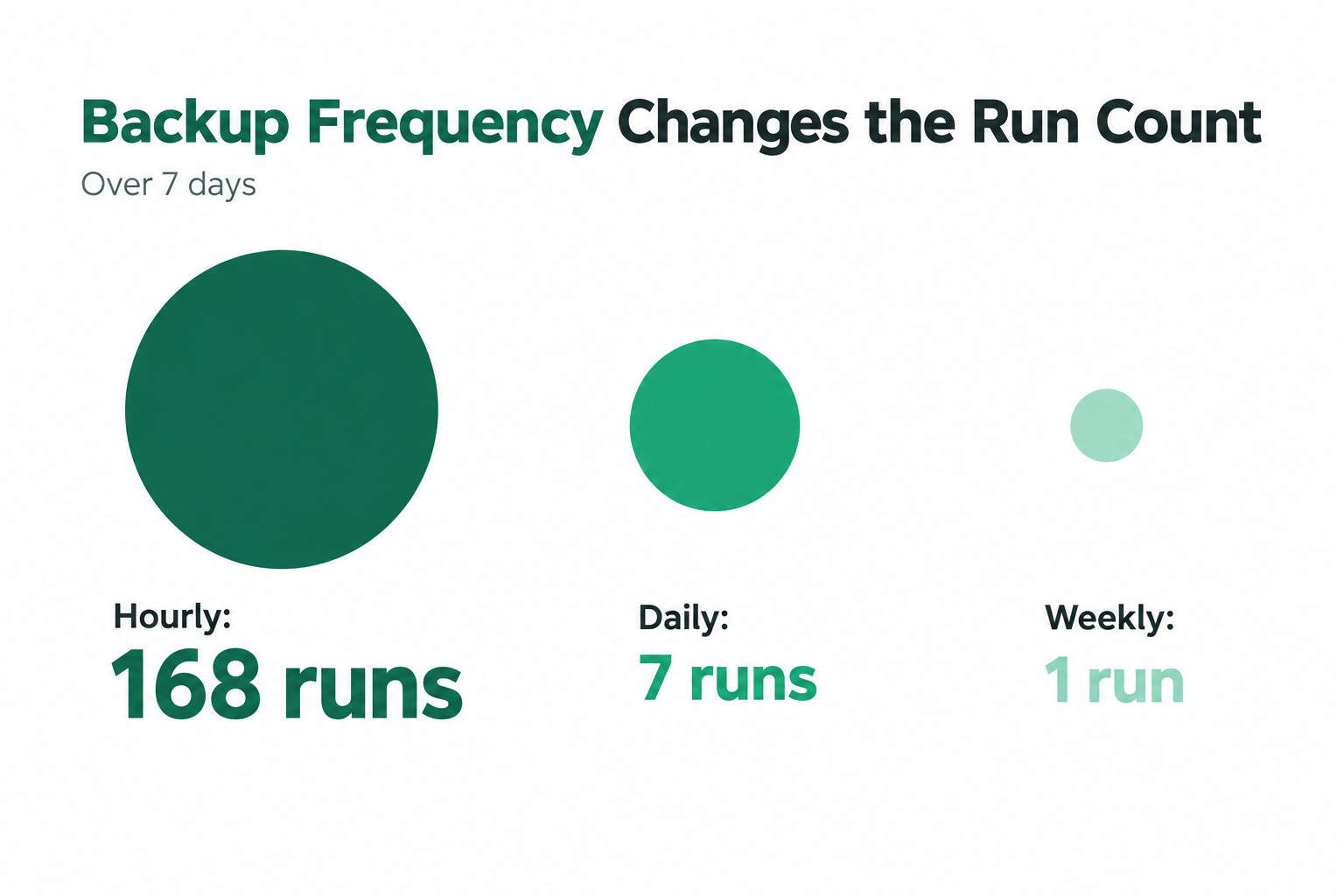
Golang Hosting includes a complimentary seven-day disaster-recovery backup, plus snapshot options. Optional backup policies run hourly, daily, or weekly. An instance snapshot captures an instance; a volume snapshot captures a volume.
Over a seven-day planning window, hourly, daily, and weekly schedules correspond to 24 × 7 = 168 scheduled runs, 7 scheduled runs, and 1 scheduled run. The useful choice depends on how much recent data you can afford to recreate.
Test restoration as well as backup creation. A worker’s binary can usually be redeployed, but queue state, configuration, and database contents need a recovery approach. Learn more about backup storage before deciding what to protect.
Golang Hosting for Background Workers and Internal Tools
A practical deployment connects four pieces: the Golang executable, its configuration, its process controls, and its dependencies. AccuWeb.Cloud supports one-click deployment and includes a Golang development environment, so your team can start with a prepared server.
Put the Service on the Server
Connect over SSH using a key, then install your application and its configuration. Run the executable under an appropriate service account rather than using root for routine application work. Root remains available for administration.
Set environment variables for the database address, queue endpoint, and other runtime settings. Grant the application only the database permissions it needs. If it runs a network listener, bind and filter access according to whether the listener serves internal or external clients.
Configure process startup and restart behavior, then exercise a normal stop and an unexpected exit. Check logs after both events. A successful SSH session proves access to the server, not that a background job has completed.
Measure Before Adding Capacity
Track queue age, completion rate, error rate, memory, and CPU together. Queue age shows how long work waits; completion rate shows whether workers are catching up. A healthy CPU graph alone cannot tell you whether jobs are completing.
When memory use is the constraint, compare Essential, Standard, and Plus in the plan table. When CPU is the constraint, compare the vCPU counts as well. Some resource changes require a reboot, so schedule changes around your worker’s shutdown and retry behavior.
Use the cost estimators to explore resources, and review vertical scaling when a single server needs more capacity. For an API-focused Golang deployment, see the guide to Golang microservices and REST APIs.
Frequently Asked Questions
Can a Golang worker keep running after I disconnect from SSH?
Yes. Configure the worker as a managed background process rather than tying it to an interactive SSH session. Test startup and restart behavior on your server.
Can I host a Golang command-line tool on the same server?
Yes. AccuWeb.Cloud Golang Hosting supports command-line tools as well as background services. Account for the tool’s CPU, memory, disk, and permissions alongside your workers.
Does a Golang network daemon need a public port?
No. A daemon needs a public port only when external clients must reach it directly. Internal services can use private networking and firewall rules.
Which plan fits a worker that needs more than 1 GB of RAM?
Essential has 2 GB RAM for $6.95 per month. Standard has 4 GB RAM and two vCPUs for $11.75 per month. Select based on measured workload and operating-system needs.
Is AccuWeb.Cloud cheaper than the compared entry servers?
Yes, on the monthly prices shown: Start is $4.95, compared with $5 for Akamai, $6 for DigitalOcean, and $7 for Lightsail. Their CPU, storage, and transfer allowances also matter.
What should I check before moving a Golang worker?
Check environment variables, private database access, job retry behavior, startup configuration, and backup restoration. Avoid running old and new workers against the same queue until duplicate processing is understood.
Can I use hourly billing for a Golang server?
Start is priced at $0.006781 per hour as well as $4.95 per month. For example, 100 hours at that rate is 100 × $0.006781 = $0.6781 before separately billed usage or add-ons.
Is there a money-back guarantee?
Golang Hosting has a 30-day money-back guarantee under its terms. AccuWeb.Cloud also has a separate cloud VM trial for eligible users.
Make the Worker Observable Before It Grows
For golang hosting for background workers and your internal tools, start with a server sized for the whole workload. Then test restarts, protect state, and measure queue progress. Root access and private networking give your team the controls to run Golang services on its own terms.

Jilesh Patadiya, the visionary Founder and Chief Technology Officer (CTO) behind AccuWeb.Cloud. Founder & CTO at AccuWebHosting.com. He shares his web hosting insights on the AccuWeb.Cloud blog. He mostly writes on the latest web hosting trends, WordPress, storage technologies, and Windows and Linux hosting platforms.