True Automatic Vertical Scaling: What It Is & How AccuWeb.Cloud Differs from AWS, Azure & GCP

TL;DR
Automatic Vertical Scaling Explained
-
- Vertical scaling increases CPU and RAM on the same server
- Most cloud providers still require reboots or downtime
- Hyperscalers prioritize horizontal scaling instead
Why AccuWeb.Cloud Stands Out
- Real-time automatic CPU and RAM scaling
- No reboot, no downtime
- No manual intervention
- Perfect for traffic spikes and variable workloads
Bottom Line
If your application demand is unpredictable, AccuWeb.Cloud delivers what hyperscalers still cannot.
Cloud promises elasticity.
Reality often delivers stress.
A sudden traffic spike.
A campaign that actually works.
An AI job that needs more memory right now.
In those moments, performance matters more than dashboards, tickets, or manual resizing.
This is where most cloud platforms reveal a hard truth:
Automatic vertical scaling is still not truly automatic on most hyperscalers.
AccuWeb.Cloud changes that.
What Is Automatic Vertical Scaling
Automatic vertical scaling is the ability of a cloud system to dynamically increase or decrease CPU and RAM on the same running server, in real time, without:
- Rebooting the server
- Replacing the instance
- Migrating workloads
- Manual intervention
Vertical vs Horizontal Scaling
- Vertical scaling: More power to the same server
- Horizontal scaling: More servers, more orchestration
Horizontal scaling is powerful, but complex.
Vertical scaling is simpler, faster, and often exactly what real-world workloads need.
The challenge is not theory.
It is availability.
The Hyperscaler Reality Check (What Actually Works and What Does Not)
When people say “AWS, Azure, or GCP support vertical scaling,” they are partially right.
The key detail most misses is where and how that scaling actually works.
Let’s break it down clearly.
AWS (EC2 and Managed Services)
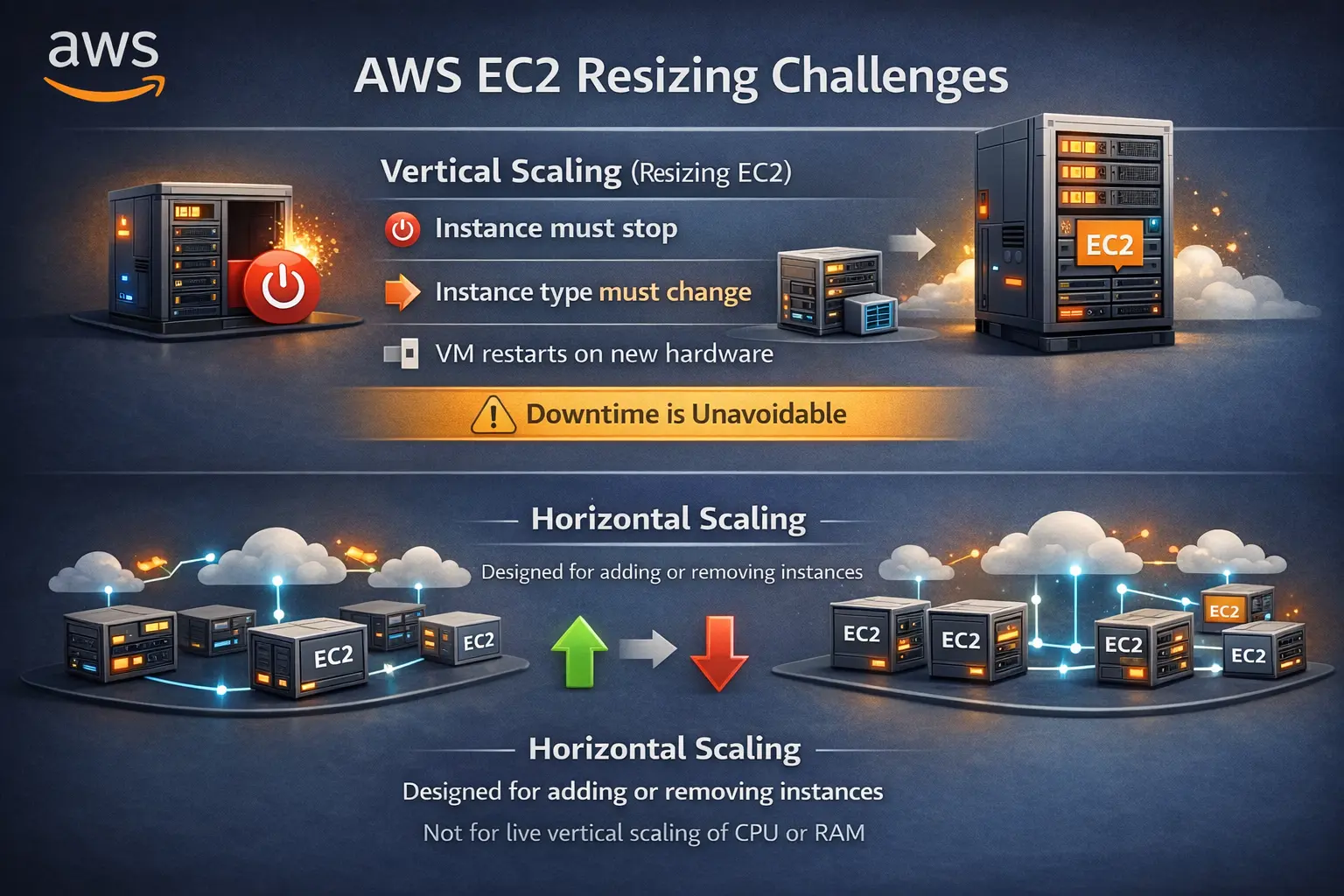
AWS does support vertical scaling, but how it works depends entirely on the service.
For Amazon EC2 (Virtual Machines)
AWS allows instance resizing, but in practice:
- The instance must be stopped
- The instance type must be changed
- The VM restarts on new hardware
- Downtime is unavoidable
AWS Auto Scaling is designed for horizontal scaling (adding or removing instances), not for live vertical scaling of CPU or RAM.
Bottom line: EC2 vertical scaling is manual, disruptive, and not real-time.
Where AWS Does Scale Vertically Automatically
AWS provides automatic vertical scaling inside specific managed services:
- Amazon Aurora Serverless
Automatically scales database capacity (Aurora Capacity Units) based on load. - Amazon EKS (Kubernetes)
Supports Vertical Pod Autoscaler (VPA) to adjust container CPU and memory requests. - Amazon RDS Storage Auto Scaling
Automatically increases storage capacity when usage thresholds are reached.
These services handle scaling internally, without user intervention.
The Important Distinction
AWS vertical scaling works well within managed or containerized services,
but not for general-purpose EC2 virtual machines.
If your workload runs directly on EC2, changing CPU or RAM still requires a top-resize-restart cycle.
Microsoft Azure (VMs and Managed Services)
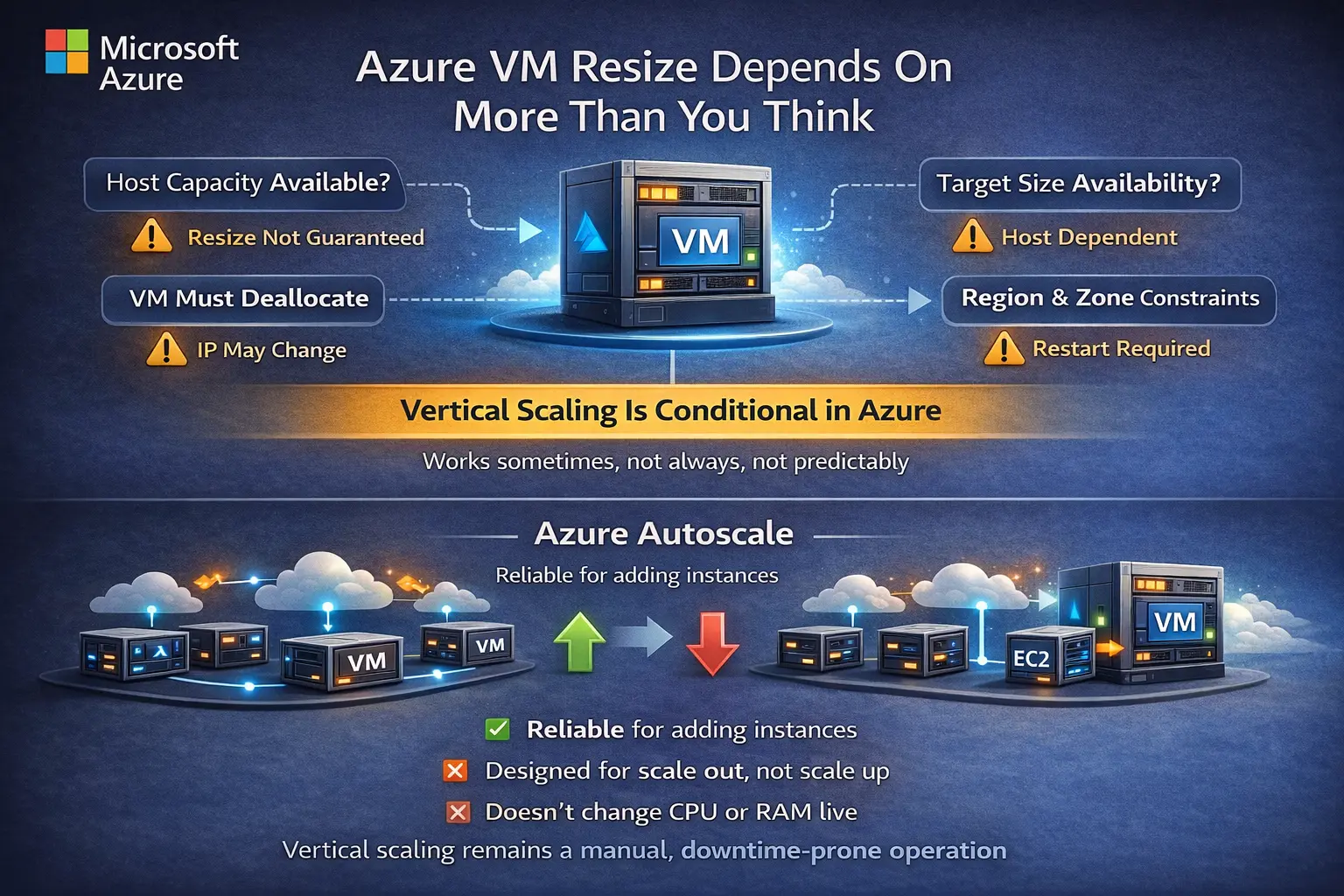
Azure supports vertical scaling, but like AWS, the experience depends on the service type.
For Azure Virtual Machines
Azure allows VM resizing, but:
- Most size changes require VM deallocation
- The VM must stop before resizing
- A restart is required after resizing
- Downtime is common
In some limited cases, resizing may work without deallocation if the target size exists on the same physical host, but this is not guaranteed or automatic.
Azure Autoscale focuses primarily on horizontal scaling, not live vertical scaling.
Bottom line: VM-level vertical scaling is manual and often disruptive.
Where Azure Does Scale Vertically Automatically
Azure provides automatic or semi-automatic vertical scaling within specific services:
- Azure SQL Database (Serverless)
Automatically scales compute (vCores) up and down based on workload demand. - Azure Kubernetes Service (AKS)
Supports Vertical Pod Autoscaler (VPA) for containerized workloads.
These services abstract the infrastructure complexity from the user.
The Important Distinction
Azure vertical scaling works best inside managed and serverless services,
but not consistently for general-purpose virtual machines.
Google Cloud Platform (GCP)
Google Cloud follows a similar design philosophy.
For Compute Engine (Virtual Machines)
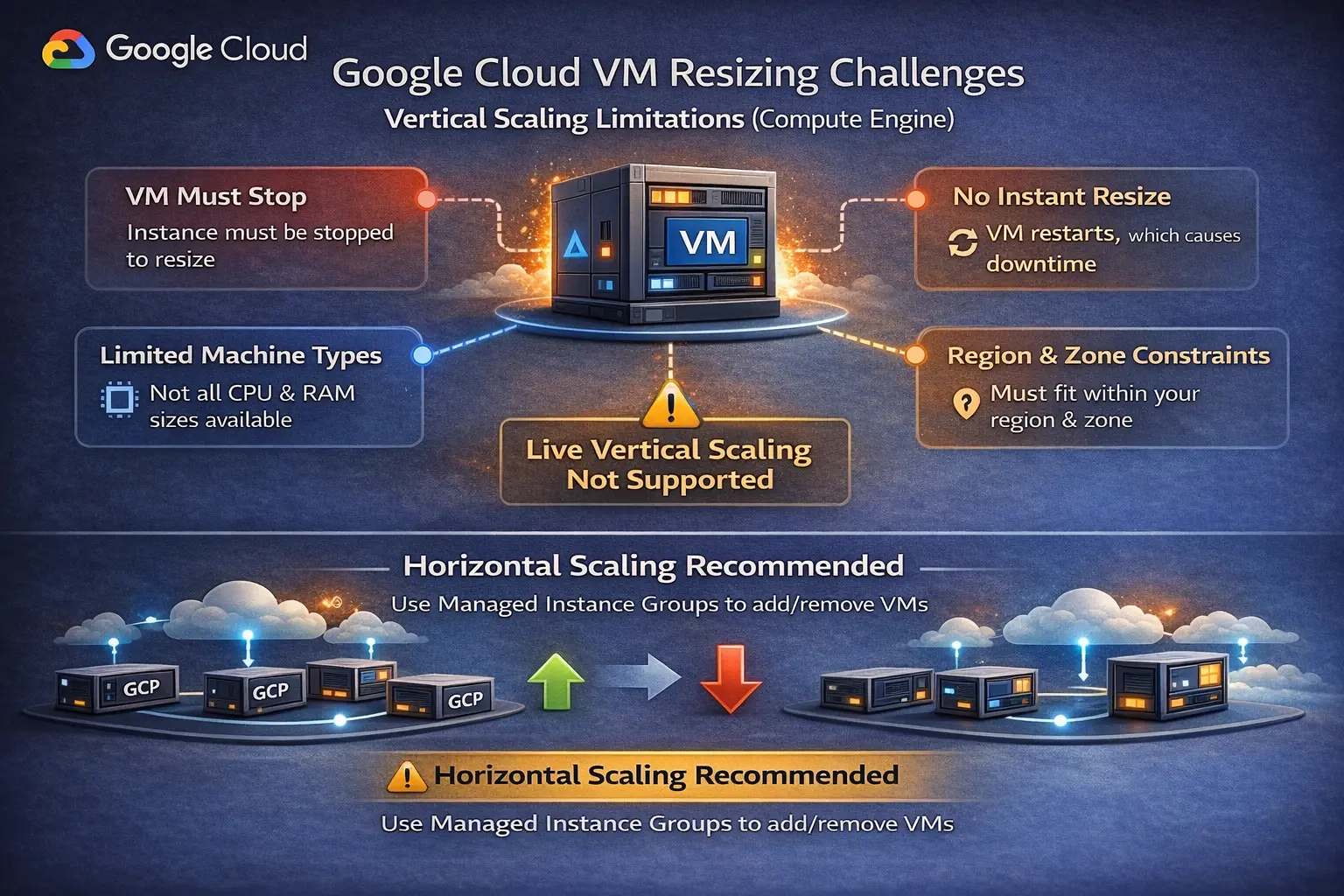
GCP allows VM resizing, but:
- The VM must be stopped to change the machine type
- CPU and RAM changes require a restart
- Live vertical scaling is not supported
GCP recommends horizontal scaling with managed instance groups for production workloads.
Bottom line: VM-level vertical scaling is manual and requires downtime.
Where GCP Does Scale Vertically Automatically
GCP provides automatic vertical scaling in specific environments:
- Google Kubernetes Engine (GKE)
Vertical Pod Autoscaler adjusts container CPU and memory requests. - Dataflow Prime
Automatically adjusts worker memory during job execution. - Cloud SQL Storage Auto-Resize
Automatically increases storage capacity (not CPU or RAM).
The Important Distinction
GCP vertical scaling is effective for containers and data processing services,
but not for standard VMs running general workloads.
DigitalOcean
DigitalOcean keeps things simple and developer-friendly, but vertical scaling remains limited.
For Droplets (Virtual Machines)
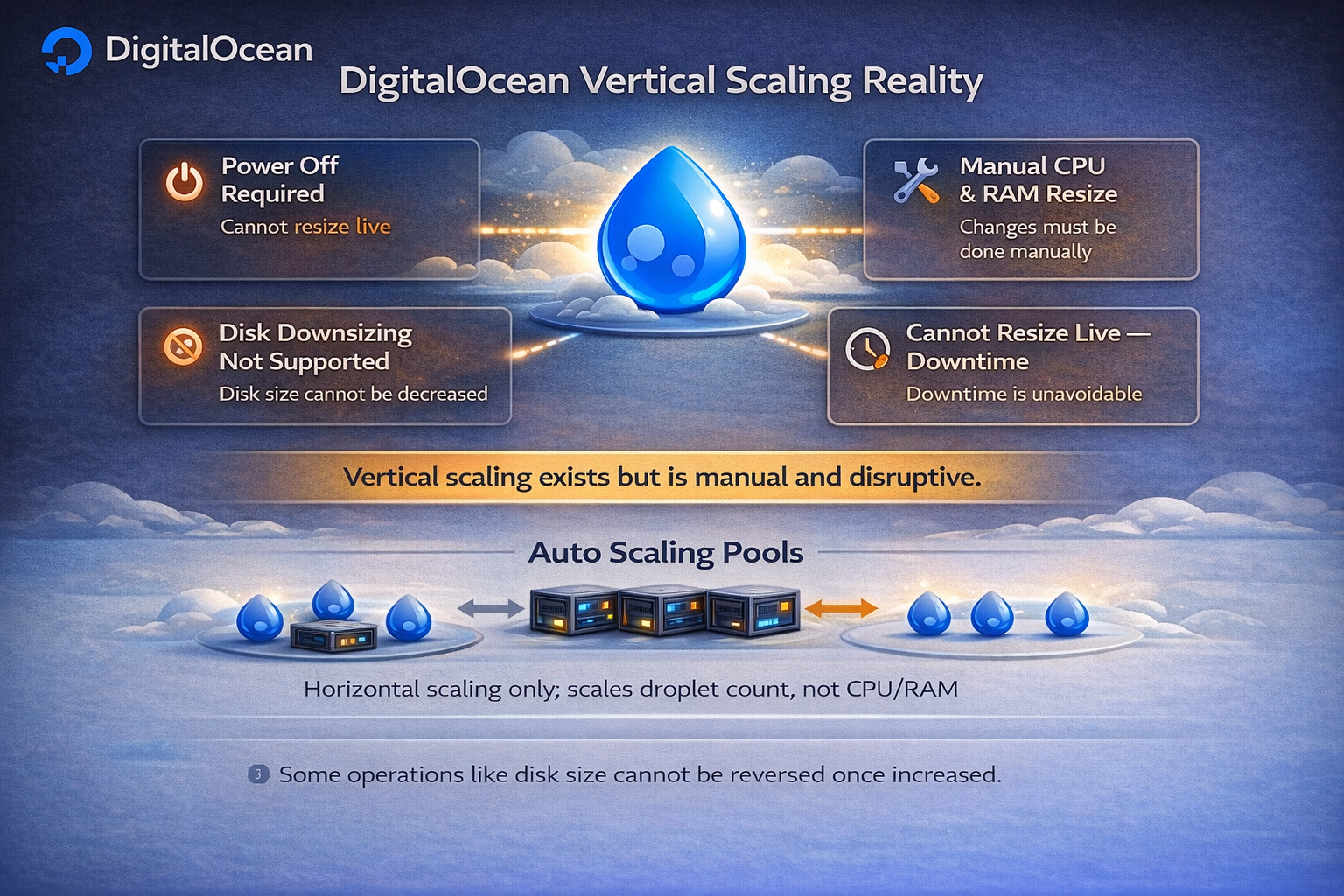
DigitalOcean supports resizing, but:
- Droplets must be powered off
- CPU and RAM changes are manual
- Downtime is unavoidable
DigitalOcean Autoscale Pools focus entirely on horizontal scaling.
Bottom line: Vertical scaling exists, but it is manual and disruptive.
Where Vertical Scaling Is Possible
- DigitalOcean Kubernetes (DOKS)
Supports Vertical Pod Autoscaler if users install and manage it themselves. - Managed Databases
Allow manual resizing and some storage expansion.
These are not automatic, one-click VM-level features.
The Important Distinction
DigitalOcean offers great simplicity, but true automatic vertical scaling is not native to its compute platform.
One Clear Pattern Across All Hyperscalers
Across AWS, Azure, GCP, and DigitalOcean:
- Automatic vertical scaling exists mainly in managed or containerized services
- General-purpose VMs still require restarts or manual actions
- Live, real-time CPU and RAM scaling at the VM level is rare
This is exactly where AccuWeb.Cloud stands apart.
Why Hyperscalers Still Avoid True Auto Vertical Scaling
This is not a lack of engineering skill. It is a design choice.
Hyperscalers optimize for:
- Massive horizontal scale
- Predictable billing units
- Infrastructure standardization
Live vertical scaling requires:
- Advanced hypervisor orchestration
- Dynamic resource rebalancing
- Accepting less rigid billing models
Reboots are treated as acceptable trade-offs.
For modern applications, they are not.
How AccuWeb.Cloud Solves This Differently
AccuWeb.Cloud was designed with a different philosophy:
Performance first. Simplicity always.
What Makes AccuWeb.Cloud Different
- Real-time CPU and RAM scaling
- No reboot
- No downtime
- No manual resizing
- Scaling triggered automatically by demand
This is not scheduled resizing.
This is not an instance replacement.
How It Works (Simple View)
Behind the scenes:
- Resource usage is continuously monitored
- CPU and RAM adjust dynamically
- Applications keep running
- Resources scale up during peaks and scale down during quiet periods
For the user:
Your application just keeps working.
Where This Makes a Real Difference
E-commerce Flash Sales
- No cart failures
- No checkout slowdowns
- No panic scaling
SaaS Platforms
- Stable performance for all tenants
- No over-provisioning
- Better cost control
AI and ML Workloads
- Dynamic memory prevents crashes
- Faster iteration cycles
Enterprise and Legacy Apps
- Vertical scaling without re-architecture
- Ideal for monolithic workloads
AccuWeb.Cloud vs Hyperscalers (Quick View)
| Feature | AccuWeb.Cloud | AWS | Azure | GCP | DigitalOcean |
| Automatic Vertical Scaling | Yes | No | Partial | Partial | No |
| Downtime Required | No | Yes | Yes | Often | Yes |
| Real-Time Scaling | Yes | No | Limited | Limited | No |
| Manual Intervention | No | Yes | Yes | Yes | Yes |
| Operational Complexity | Low | High | High | Medium | Low |
Why This Changes Everything
Automatic vertical scaling is not a technical luxury.
It changes how teams feel about infrastructure.
- No fear of traffic spikes
- No late-night alerts
- No capacity guesswork
- No paying for idle resources
The cloud should adapt to your business.
Not the other way around.
People Also Ask (And You Should Too!)
Q) What Is Automatic Vertical Scaling?
A) Automatic vertical scaling is the ability to increase or decrease CPU and RAM on a running server in real time, without rebooting, replacing the instance, or causing downtime.
Q) Do AWS, Azure, GCP, or DigitalOcean Support True Automatic Vertical Scaling?
A) No.Most hyperscalers require stopping or restarting virtual machines to change CPU or RAM. Their auto scaling solutions mainly focus on horizontal scaling, not live vertical scaling.
Q) Why Hyperscalers Struggle With Vertical Scaling
A) Hyperscalers are designed for massive horizontal scale and standardized billing.
Live vertical scaling requires advanced hypervisor orchestration and flexible resource allocation, which conflicts with their architecture and pricing models.
Q) How AccuWeb.Cloud Is Different
A) AccuWeb.Cloud provides true automatic vertical scaling by dynamically adjusting CPU and RAM in real time, without reboot, downtime, or manual intervention.
Q) Which Cloud Is Best for Unpredictable Traffic?
A) AccuWeb.Cloud is best suited for unpredictable workloads because it supports live automatic vertical scaling without service interruption.
Final Thought
Hyperscalers excel at massive scale.
AccuWeb.Cloud excels at adaptive performance.
Automatic vertical scaling is no longer a nice-to-have feature.
It is a competitive advantage.
And today, AccuWeb.Cloud delivers what many global cloud providers still cannot.

Jilesh Patadiya, the visionary Founder and Chief Technology Officer (CTO) behind AccuWeb.Cloud. Founder & CTO at AccuWebHosting.com. He shares his web hosting insights on the AccuWeb.Cloud blog. He mostly writes on the latest web hosting trends, WordPress, storage technologies, and Windows and Linux hosting platforms.