

Tired of AWS Overbilling? Why It Happens and How Businesses Are Finally Fixing It
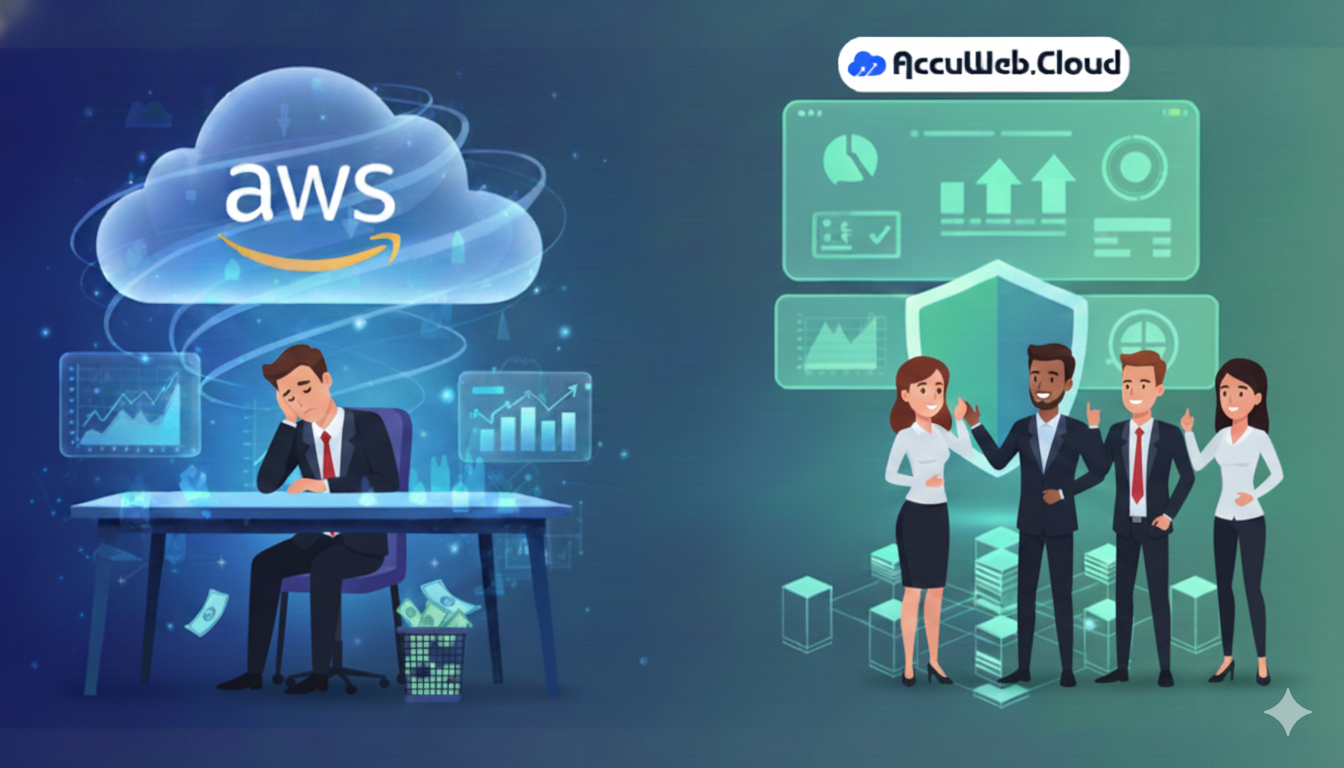
TL;DR
AWS bills often spike due to static EC2 sizing, hidden service charges, and lack of real-time vertical scaling. Businesses are reducing cloud costs by switching to platforms like AccuWeb.Cloud that offer live CPU and RAM scaling, predictable billing, and no surprise overages.
AWS is often the default cloud choice for startups, SaaS companies, and growing digital platforms. It promises global reach, reliability, and scalability.
At first, everything feels under control.
Servers are easy to launch.
Traffic is manageable.
Bills stay predictable.
Then growth happens.
Traffic spikes during campaigns. New features roll out. Background services multiply. One month later, the AWS bill arrives far higher than expected.
No warning.
No obvious misconfiguration.
Just a number that does not make sense.
This problem is so common that queries like “Why is my AWS bill so high?” and “AWS unexpected charges” are searched daily across Google, forums, and AI tools.
So what causes AWS overbilling, and how are businesses fixing it?
Why AWS Bills Become Unpredictable Over Time
Why is my AWS bill so high?
AWS bills become high due to over-provisioned EC2 instances, data transfer charges, storage snapshots, load balancers, and background services. Since AWS does not support real-time vertical scaling, users often pay for unused CPU and RAM even during low traffic periods.
1. AWS Pricing Is Fragmented Across Many Services
In AWS, your cloud bill is rarely about just the server.
Costs silently accumulate from:
- EC2 instance hours
- EBS volumes and snapshots
- Load balancers
- NAT gateways
- Data transfer and egress
- Auto Scaling groups
- Always-on managed services
Each service is billed separately. As architectures grow, costs spread across multiple line items.
Shocking fact:
For many AWS users, data transfer alone accounts for 20–35 percent of the total monthly bill, often without being noticed until billing closes.
2. AWS Does Not Support Live CPU or RAM Scaling
Does AWS support automatic vertical scaling?
No. AWS EC2 does not support live CPU or RAM scaling. Instances must be stopped and restarted to change resources or scaled horizontally by adding more instances.
To avoid downtime, teams over-provision resources in advance.
This leads to paying for peak capacity 24/7, even when traffic is low.
3. Free Tier Does Not Mean Free Forever
Why do AWS charges appear even with free tier usage?
AWS free tier limits are easy to exceed due to storage growth, snapshot retention, background services, and data transfer charges, which continue billing silently.
By the time alerts appear, charges have already accumulated.
4. Cost Visibility Comes After the Spend
AWS Cost Explorer and Budgets show what already happened.
They do not prevent:
- Over-provisioning
- Idle resource billing
- Sudden cost spikes
For teams without FinOps expertise, this visibility arrives too late.
Real Example: How a $220 AWS Bill Became $780
A growing SaaS company ran a content-heavy web application on AWS.
Early stage
- One EC2 instance
- Moderate traffic
- Monthly bill: $180–$220
Growth stage
- Marketing campaigns increased traffic
- CPU spiked during peak hours
- Memory pressure caused slowdowns
To stay safe, the team upgraded:
- A larger EC2 instance
- Additional storage
- A load balancer
Result
- Monthly bill increased to $780
- Peak usage lasted only a few hours per day
- Most resources stayed idle the rest of the time
The issue was not usage.
The issue was static infrastructure reacting to dynamic demand.
What Businesses Actually Want From Cloud Infrastructure

When users search for AWS alternatives, they are not just looking for cheaper servers.
They want:
- Predictable monthly billing
- Automatic CPU and RAM scaling
- No surprise charges
- No downtime during scaling
- No over-provisioning
- Clear cost visibility
In short, they want the cloud to adapt automatically.
How Modern Cloud Architecture Fixes AWS Overbilling
How do modern cloud platforms reduce cloud costs?
Modern cloud platforms reduce costs by scaling CPU and RAM in real time based on demand, eliminating over-provisioning and billing users only for resources actually used.
This approach is known as real-time auto vertical scaling.
Resources scale up during demand spikes and scale down when traffic drops.
Billing follows usage, not reserved capacity.
How AccuWeb.Cloud Solves the AWS Billing Problem
AccuWeb.Cloud is built on adaptive cloud architecture designed to remove AWS billing pain.
Real-Time CPU and RAM Scaling
AccuWeb.Cloud supports live vertical scaling with no reboot and no downtime.
Resources scale automatically up and down, eliminating idle billing.
Predictable Pricing Without Hidden Charges
AccuWeb.Cloud avoids:
- Complex service-based billing
- Unexpected data egress charges
- Silent background costs
Enterprise Infrastructure Without Enterprise Complexity
AccuWeb.Cloud runs on Tier-III certified, enterprise-grade infrastructure.
Explore global data centers here: https://accuweb.cloud/data-center
Human + AI Support
When billing and performance intersect, human support matters.
Real Cost Comparison: AWS vs AccuWeb.Cloud
Scenario
- One production web application
- Traffic spikes during business hours
- Low usage at night
- Consistent performance required
Typical AWS Setup
| Component | Monthly Cost |
| EC2 Instance (over-provisioned) | $320 |
| EBS + Snapshots | $90 |
| Load Balancer | $40 |
| Data Transfer | $120 |
| Monitoring | $60 |
| Total | ~$630 |
Most capacity remains unused, but billing continues.
AccuWeb.Cloud Setup
| Component | Monthly Cost |
| Cloud Instance (16 vCPU, 64 GB RAM) | $180 |
| Auto Scaling Overhead | $0 |
| Storage | Predictable |
| Total | ~$180 |
Result
- Around 60 percent lower cost
- No downtime
- No reboots
- Predictable monthly billing
AWS vs AccuWeb.Cloud at a Glance
| Feature | AWS EC2 | AccuWeb.Cloud |
| Live CPU and RAM Scaling | No | Yes |
| Reboot Required | Yes | No |
| Billing Predictability | Low | High |
| Over-Provisioning | Required | Not required |
| Cost Visibility | Post-usage | Real-time |
| Support Model | Ticket-based | Human + AI |
When Does It Make Sense to Switch?
Businesses typically switch when:
- Cloud bills grow faster than revenue
- Traffic becomes unpredictable
- Scaling causes downtime
- Cost optimization consumes engineering time
If understanding your cloud bill feels harder than managing your application, the infrastructure is the problem.
Final Thoughts
AWS is powerful, but power comes with rigidity.
For variable workloads, the real problem is not cloud cost.
It is cloud inflexibility.
AccuWeb.Cloud shows that cloud infrastructure can be adaptive, predictable, and fairly priced without sacrificing performance.
People Also Ask(And You Should Too!)
Q) Why is my AWS bill so high even when traffic is low?
A) AWS continues billing for allocated resources regardless of usage. EC2 instances do not scale down automatically, so unused CPU and RAM remain billable.
Q) Does AWS have automatic vertical scaling?
A) No. AWS EC2 requires stopping and restarting instances to change CPU or RAM, or adding more instances horizontally.
Q) What is the best AWS alternative for predictable pricing?
A) Cloud platforms with real-time vertical scaling and usage-based billing offer more predictable costs than AWS.
Q) Is AccuWeb.Cloud cheaper than AWS?
A) For variable workloads, AccuWeb.Cloud can reduce costs by up to 60 percent by eliminating over-provisioning and surprise charges.
Q) Can I migrate from AWS without downtime?
A) Yes. Many applications migrate using parallel deployments or phased transitions to avoid downtime.

Jilesh Patadiya, the visionary Founder and Chief Technology Officer (CTO) behind AccuWeb.Cloud. Founder & CTO at AccuWebHosting.com. He shares his web hosting insights on the AccuWeb.Cloud blog. He mostly writes on the latest web hosting trends, WordPress, storage technologies, and Windows and Linux hosting platforms.

